Showing posts with label Bandung Architectural Heritage. Show all posts

Friday, June 17, 2011

Vila Isola at Dusk


Some buildings are called an architectural heritage not for nothing. They are beautiful from whichever angle you see them, whatever the time of the day and whatever the season is. I think Vila Isola is such a building. I have photographically explored this building from many different angles and time of the day, and I never get bored with it.

I took this photo from the front gate of my office, which is located just across a small in-campus road from it, at dusk a couple of days ago just as I was getting out of the office. The the light of the early evening sky shining upon it gave me another photographic opportunity to marvel at its beauty. The silhouetted arch framing is that of the entrance columns (?) into my office building.

Since some of my friends and this blog visitors have sometimes asked me what camera(s) I use, I'd like to this opportunity to say once again that I don't usually use fancy or expensive cameras. I took this photo (and many others I have posted here) with a small, inexpensive pocket camera that I always have with me where ever I go. I'd rather not say what the brand is, but if you want to know you can email me.

This post is Bandung Daily Photo's participation in this weeks Skywatch Friday meme. See more sky-related photos from participating blogs from around the world here.

Thursday, June 16, 2011

Villa Isola Fish Pond


A father with his daughters enjoying the fish pond at the southern garden of Vila Isola on a Sunday morning.

I have previously posted several photos and stories about this villa before. As you may remember from those posts, Vila Isola is one of Bandung's most iconic art-deco architectural heritage. Built as a private residence in the early 1930s for an Italian-Dutch media tycoon Dominique William Berretty, the founder of the Aneta press-agency in the Dutch East Indies, Vila Isola was turned into a hotel just after his death in 1934. Then it became the Bandung headquarters of Japanese occupational army in the early 1940s when Japanese Imperial Army occupied the Indonesian archipelago and an Indonesian resistance army militia headquarters during the wars for independence. After the Indonesian Independence, it was renovated and made as the central piece of the newly established Teachers' Education College or PTPG campus in 1954.

The name of the college in which this building stands has changed several times since then: Fakultas Keguruan dan Ilmu Pendidikan (Faculty of Teacher Training and Pedagogy) or FKIP of the newly established Padjajaran University in 1958, Institut Keguruan dan Ilmu Pendidikan (Institute of Teacher Training and Education Science) or IKIP Bandung in 1963, and Universitas Pendidikan Indonesia (Indonesia University of Education) or UPI in 2004.

Since 2010, the building and its surrounding gardens have been renovated to revive its past grandeur. The renovation of the park that you can see at the background of the picture was completed this year and is now designated at Vila Isola Heritage Park.

Wednesday, January 12, 2011

Gedung Pakuan


This is Gedung Pakuan (lit. Pakuan Building or Mansion) on Jalan L.R.E. Martadinata No.1.

Gedung Pakuan is the official residence of the Governor of West Java Province. It was built in 1864 upon the order Van der Moore (then residen or governor of Priangan) when he decided to move the capital of Priangan from Cianjur to Bandung.

This piece Indische Empire Stijl (Indian Emperial Style) architeture was said to be designed by the head engineer of Departement van Burgerlijke Openbare Werken (Department of Public Works). Unfortunately, of all the books I've read about it, none mentioned the name of the person.

Gedung Pakuan is considered to be one of the most important pieces of Bandung's architectural heritage and, being the official residence of the governor of West Java, one of the best preserved.

Many head of states and important public figures have stayed in this mansion. The list includes the King of Siam (Thailand) Somdet Phra Paramendr Maha Chulalonkorn (1901), the Prime Minister of France Georgeos Clemenceau (1921), Queen Juliana and Prince Bernhard of the Netherlands (1971), the President of Yugoslavia Josip Bros Tito, the Soviet Union's President Voroshilov, The United States' Attorney General Robert Kennedy, and even Charlie Chaplin and Mary Pickford.

Friday, October 8, 2010

More of Villa Isola


I took this photo yesterday afternoon from the UPI's Faculty of Language and Art building with my mobile device. It was exceptionally sunny after a lot of rainy days this year and the clouds looked interesting.

This is also my first posting from my mobile device. Let's see how it turns out. If it looks good, then I can probably post/report life from anywhere.

Have as good Friday everyone!

Saturday, February 20, 2010

Bandung Architectural Heritage: Kantor Pos Besar Bandung


This is the facade of Kantor Pos Besar Bandung (Bandung Grand Post Office) at Jalan Asia Afrika 47. In front of it is the sculpture of Universal Postal Union or Union Postale Universalle (UPU). The building is painted grey and orange because they are the colors of PT Pos Indonesia (Indonesian Postal Company).

The Grand Post Office building is listed as one of Bandung's architectural heritage by Bandung Heritage Society. This building was built in 1928 and was designed by architect J. van Gent.

Friday, December 25, 2009

Heart to God Hand to Man


This is the picture of the territorial headquarters of The Salvation Army Indonesia on Jalan Jawa 20, Bandung. The building it occupies was designed by Brinkmen & Voorhave and was built in 1920. It is listed as one of Bandung's Architectural heritage.

You might wonder why there is no Christmas decoration on the premises. Well, I took the photo early in November, so the Christmas decoration was not put up yet. With or without decorations and festivities, I think what's more important about Christmas is the spirit. And I think the Salvation Army's slogan "Heart to God Hand to Man" captures it well.

I'm not a Christian or Catholic, but I believe whatever our faith is, the measure of our piety is how useful we are to other human beings. With this, I would like to wish those of you who celebrate it, Selamat Natal! (Marry Christmas!)

Wednesday, December 31, 2008

Bandung Architectural Heritage #6: Jalan Braga 43


These stained glass windows and the lamp case (lamp post) of the building on Jalan Braga 43 are some of the remaining evidence of Braga's glorious past, which had earned it the title of "De meest Europesche winkelstraat van Indie" (The most European street of the Indies).

This building was built in 1915 and is another example of R.L.A. Schoemaker's architectural masterpiece designs.

Monday, December 29, 2008

Bandung Architectural Heritage # 5: Jalan Braga 135


These colorful windows belong to a building on Jalan Braga (Braga Street) 135, across the street from Bank Indonesia building. There is no official name for this building today as it has been left vacant for sometime. Listed as one of Bandung's Architectural Heritage by Bandung Society for Heritage Conservation, this building is another example of the Schoemaker brothers' architectural masterpieces. R.L.A Sshoemaker (the brother of C.P. Wolff Schoemaker) designed this building, which was erected in 1917.

Throughout its history, this building has been used for different purposes. I do not have any information about what this building was used for before the Indonesian independence, but after the Indonesian independence, it was the provincial headquarters of the Indonesian Police (POLDA Jawa Barat) until the 1990s. It was then leased and made into a factory outlet boutique - that's when the windows were colored like this.

Here is what the wide angle shot of the building looks like:

Tuesday, December 2, 2008

Bandung Architectural Heritage # 5: Villa Isola - The Western Facade


This is the western facade of Villa Isola (now Bumi Siliwangi and the rector's office the Indonesia University of Education or Universitas Pendidikan Indonesia) as seen from one of the classrooms of the Faculty of Language and Art Education building located west of it.

Villa Isola is located on the northern hills of Bandung on Jalan Dr. Setiabudhi 229.

I have posted three pictures and the stories about this building before: here, here, and here.

Wednesday, October 22, 2008

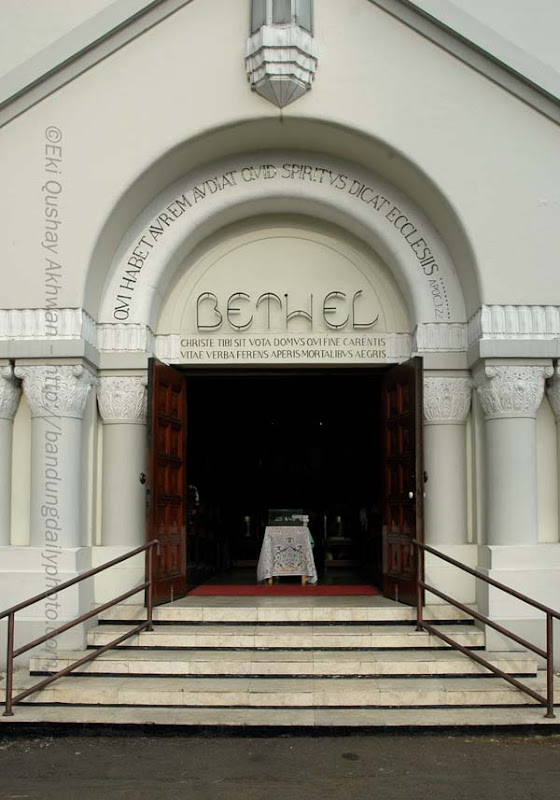
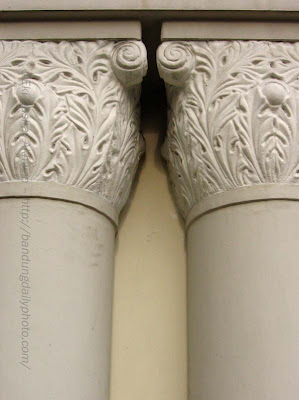
Bandung Architectural Heritage # 4: The Bethel Church on Wastukancana Street


The Bethel Church on Wastukancana Street #1 was designed by architect Prof. C.P. Wolff Schoemaker and constructed in 1925. It is listed by Bandung Society for Heritage Conservation (Paguyuban Pelestarian Budaya Bandung) and the Bandung municipal government as one of Bandung's colonial architectural heritage buildings.

Prof. C.P. Wolf Schoemaker is one of the most prolific and highly acclaimed architects in Indonesia (then Ductch East India) of the early 20th century. Many of his works now become Bandung's landmarks. I have posted the photos and stories of two other buildings that he designed here and here.


Wednesday, October 15, 2008

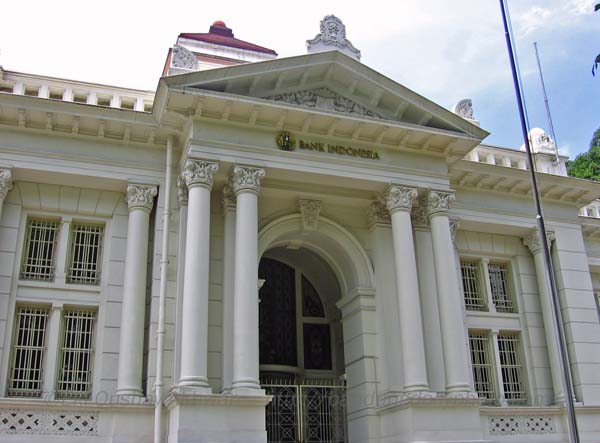
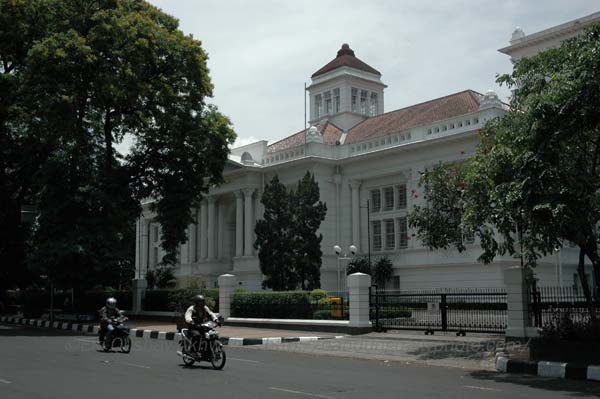
Bandung Architectural Heritage # 3: Bank Indonesia Building


Among its many other nicknames, Bandung was once also dubbed Indonesia's "Colonial Architectural Laboratory". According to journalist and writer Her Suganda (2007), this nickname was given because the architectural styles of most of the historical buildings in this city do not reflect the local, traditional architectural style. Buildings with different kinds of architectural styles, e.g. Netherlands' Indische/Indische Empirestijl, Roman Gothic, Classic, Neoclassic, Art Deco, Art Noeveau, etc., can be found in this city. Most of these buildings were built at about the same period (1920's to 1930's). According to historical records, 400 buildings of different architectural styles were built within this 20 year period. No fewer than 60 architects were involved in making Bandung as a colonial architectural laboratory, of which, according to historian Huip Akihary (Architectuur Stedebouw in Indonesie 1870 - 1970), 16 were top architects of the time.

Since I started this blog, I have at least posted two examples of Bandung's architectural heritage, here and here. Today's photos are of the building of Bank Indonesia on Jalan Braga (Braga Street), Bandung. This building was designed by architect Edward Cuypers and constructed in 1917 for Javache Bank (Bank of Java).

Text and pictures by Eki Qushay Akhwan

Wednesday, October 8, 2008

Gedung Sate #2: Southern Facade and Some Architectural Notes

SOUTHERN FACADE OF GEDUNG SATE copyrights Eki Akhwan

This is the photo of the southern facade of Gedung Sate and its surrounding tropical gardens.

Some architectural notes of Gedung Sate:
Gedung Sate was designed by architect J. Gerber. The construction began on July 27, 1920, and was completed in four years. According to Bandung historian Haryoto Kunto, thousands of workers were involved in its construction, including a number of craftsmen and artisans who were especially invited from China to do the detailed ornaments of the building.

Gedung Sate's architecture is unique in that it combines Western architectural design and elements adopted from local and regional architecture. The tiered roof at the center, for example, is said to be adopted from the Balinese temple "meru" structure. The ornaments of the main gate at the front is quite probably adopted from Thai temple architecture. While the doors, huge windows, and some wall ornamental features bear resemblance to Indian and Spanish architectural elements.

Gedung Sate has five levels (floors). The first three floors house the different departments of the Provincial Government of West Java. The fourth floor functions as an exhibition hall and a theater where historical photographs of Bandung and West Java are exhibited and a 30 minute documentary film of the same are screened for visitors. The fifth floor, which is located right under the tiered roof, can only be accessed through a speacial staircase. It functions as a terrace where the governor of West Java entertains guests of honors for tea or coffee. From this terrace tower, one can see the majestic Mount Tangkuban Parahu (which literally means: capsized boat) in the north and other mountains surounding Bandung plateau.

Tuesday, October 7, 2008

Gedung Sate #1: The Front View (Northern Facade)

GEDUNG SATE #1 copyrights Eki Akhwan

Since I started this blog, I have mentioned "Gedung Sate" (the name of West Java Gubernatorial office mansion) quite a few times, but I have never really posted a photo that shows what it looks like in whole. The reason for this is that I did not feel that I had a decent enough photo of it that would do justice to depict its beauty. (I did have quite a number of Gedung Sate photos, but none of them were really as decent as this one.)

Gedung Sate (literally means: skewered barbeque building) is considered to be the quintessential landmark of the city of Bandung for its unique architecture, its historical significance in the development of the city, and the function it serves today (it is the seat of the governor of West Java Province, of which Bandung is the capital city). The name itself refers to the "sate" like structure on top of its tiered roof.

I'm going to share with you its history and its unique architectural features as I post more photos of its different parts tomorrow. For now, here is Gedung Sate's northern facade (frontal view) as seen from Jalan Diponegoro (Diponegoro Street).

Saturday, September 13, 2008

The Southern Facade of Villa Isola

Villa Isola 2 copyrights Eki Akhwan


Text and picture by Eki Qushay Akhwan
I received quite a number of great comments for my yesterday's Skywatch Friday post about Villa Isola or Bumi Siliwangi. Thank you all.

My good friend Virginia of Birmingham, Alabama, Daily Photo asked me if I could post a closer look photo of the building. Her (and your) wish is my command. So, here it is another photo of Villa Isola or Bumi Siliwangi. This is the southern facade of the building, the one overlooking the valley with the view of the city of Bandung underneath. (Yesterday's photo was that of the northern facade overlooking Mt Tangkuban Parahu.)

A little bit more information about the building:
Villa Isola and its surrounding gardens occupied an area of 120,000 square meters, cost about a half million of the 1930's Dutch guilders to build (I don't how much that would be in today's money value, but it must be a lot). The name Villa Isola itself comes from a placard that Barretty had ordered to be made and placed that read "Me Isolo e Vivo" (in Italian) which means "I isolate my self and live." Back then, Villa Isola was of course a remote countryside area.

Friday, September 12, 2008

The Historic Villa Isola - A Skywatch Post

VILA ISOLA copyrights Eki Akhwan

Text and picture by Eki Qushay Akhwan


Villa Isola (now called Bumi Siliwangi) is the rectorate office of Bandung's Indonesia University of Education (UPI). Located on Jalan Dr. Setiabudhi 229 overlooking the valley with the view of the city underneath, it is arguably one of the most beautiful historical buildings in Bandung and one of the most celebrated examples of art deco architectural heritage in the Asia Pacific region.

Villa Isola was built in 1932-1933 by a reknown Dutch East India's architect Wolff Schoemaker for the Dutch media tycoon Dominique William Berretty. Unfortunately, he did not live long enough to enjoy his treasured home villa. He died in 1934 in a plane crash enroute from Batavia (now, Jakarta) to Amsterdam six months after he moved into the villa.

Upon his death, the villa was sold and turned into a hotel. When the Japanese invaded what was then the Dutch East India in 1942, the building once again changed hands and became the headquarters for the Japanese Imperial Army in Bandung. The Indonesian people's liberation army took it over from the Japanese in 1945 when Indonesia declared it's independence and made it their headquarters. In 1954, the building was restored to its original condition and made into the main offices of what was then Perguruan Tinggi Pendidikan Guru (PTPG), Indonesia's first teachers' college, and what is now the Indonesia University of Education (UPI).

About the Photo:
I took this photo from the parking lot of my newly constructed office building, which is located just across a narrow on-campus road from this building a couple of days ago. It had been cloudy that day, but I was lucky. By the time I finished my classes and was ready to go home that afternoon, the sky cleared a bit and provided an excellent lighting condition for this beautiful skywatch shot.

Welcome to and enjoy my second Skywatch Friday post! And thank you for your visit and comment.

Sunday, July 20, 2008

Bandung Cathedral: The History

5 JULI 2008 NIKON D70 069B

Text and picture by Eki Qushay Akhwan

The Bandung Cathedral or the Saint Peter Church on Merdeka Street (merdeka means freedom) is one of the most notable landmarks of the city of Bandung.

The church, which was designed by Ir. C.P. Wolff Schoemaker, was built as part of the Civic Center area (which includes a city hall, a park, a school, a police station, a bank, and a Protestant church) when the city of Bandung received its municipality status (Dutch: gementee) on April 1, 1906. Its construction began in 1921 and was completed and consecrated by Mgr. Luypen on February 19, 1922.

The Saint Peter Church replaced the Saint Regis Church which had previously served the Catholics in Bandung from 1895.

Catholics make up about 3.05 percent (or about 6.5 millions) of Indonesian population (as of the year 2000).