Showing posts with label Dance. Show all posts

Tuesday, March 2, 2010

My World: Sisingaan

Sisingaan (also called Gotong Singa) or the lion dance is a Sundanese performace art that is originally from the area of Subang in the northern coast of West Java.


This performance consists of several subsets of performances. They include:
(1) Tatalu or arang-arang bubuka, a dynamic musical opening;
(2) Kidung or kembang gadung, a singing performance;
(3) Ibingan, a dancing performance;
(4) a set of accrobatic performances, and
(5) a closing musical performance.


The name "sisingaan" is derived from a pair of lion-like figures that become the central attraction of the show. These lions are usually used to carry children like the ones you see in the pictures.


Sisingaan can be performed at any helaran (festivals). But it is usually performed at circumscision ceremony and other carnivals.

This post is linked to My World Tuesday, a weekly meme where photo bloggers show their worlds through pictures. Please click the link to see posts from paricipating bloggers from around the world.

Wednesday, January 28, 2009

Topeng Cirebon


This is a pair of Topeng Cirebon (Cirebonese Masks).

Topeng Cirebon is the masks and the name of a traditional dance (called Tari Topeng Cirebon) from the West Javanese area of Cirebon of which these masks are the essential attire.

At this time, I do not yet have the photos and videos of the dance. I'll post them when I do.

Monday, January 26, 2009

Chinese New Year in Bandung: The Barongsai Performance


As of mid-night last night, Chinese all over the world welcome the new lunar year of 2560. Happy New Year to those who celebrate it.

Although Chinese only makes up a small percentage (roughly about 5 - 7 percent) of the Indonesian population, the Chinese New Year, called Imlek or Sin Tjia in Indonesian, is a national holiday and a festive celebration here. The celebrations involve not only the ethnic Chinese but also Indonesians of other ethnicity.

The Chinese would normally go to the temple to pray on the New Year's Eve. It is also customary for them to give "Ang Pao" (envelopes containing gift money) to the poor and their relatives after the prayer, have a family gathering, feast, and fire works. In addition to these, different cultural performances are also staged. One such performances - and the most popular here - is the Barongsai (the Dragon-Lion Dance) shown in these photos.

I took these photos at Ciwalk (Cihampelas Walk) today. In the top photo, a child is giving an Ang Pao to one of the Barongsais. The bottom photo shows the crowds enjoying and cheering at the various acrobatic tricks that these Barongsais were performing.

Thursday, December 18, 2008

UPI Students and Faculty Members Plan to Break The Indonesian Record of The Most Numerous Saman Dancers


These students of the Faculty of Language and Art Education of the Indonesia University of Education (UPI), Bandung, were gathering at the university's sports complex today to practice and rehearse for what is planned to be Indonesia's record breaking number of dancers performing Tari Saman (Saman Dance).

The current record was made on June 8 this year at the occasion of the celebration of the 100th anniversary of Indonesia's national awakening at Gelora Bung Karno (Soekarno Sports Complex and Stadium) in Jakarta. 600 people performed the dance then. This time The Faculty of Language and Arts Education of UPI is trying to break that record by involving 700 of its students and faculty members to perform the dance.

Saman Dance is originally from the Indonesian province of Nangroe Aceh Darussalam (Aceh) in the northern tip of Sumatra Island. It is a very dynamic group dance with highly sinchronized choreography.

To see in motion what the rehearsal was like, please check this 30 second YouTube video streaming from Bandung Daily Photo's new sister, Bandung Daily Video.

Tuesday, November 4, 2008

My world: Jaipongan, A West Javanese Cultural Heritage


"Jaipongan" is a relatively new creation dance. The correography of this dance is attributed to Gugum Gumbira, a prominent Bandung artist, musician, dancer, and correographer. It became popular in the early 1980s.

The correography of "jaipongan" is derived from/inspired by older West Javanese traditional folk "socialization" dances such as "ketuk tilu", "kliningan", "bajidoran" and some movements of "pencak silat" (Indonesian traditional martial art). It is called a socialization dance because it is primarily performed as an entertainment (as compared to dances that are performed for rituals or other ceremonial occasions) where members of the audience are invited to take part and interact with the dancer(s) and other members of the audience.

"Jaipongan" by the way is a very dynamic dance with swift, quick, and rhythmical motions and music.

This post is my participation for the meme MY WORLD.

Tuesday, October 28, 2008

My World Tuesday Post: The Dance of The Peacock


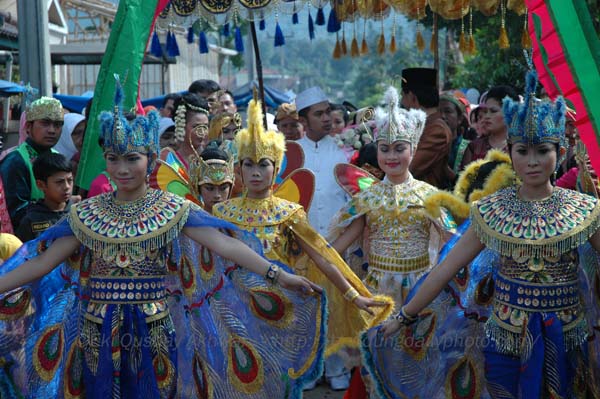
I know, I promised you that I'd post the second installment of the photo essay about Bandung's traditional wedding; but the essay involves a lot of photos and quite a bit of a story to tell, and frankly speaking I'm a bit busy today and don't have the time to prepare and upload the photos and write the story. So, instead of continuing with the essay, today I bring you this photo of these beautiful "Tari Merak" dancers.

These "Tari Merak" (Dance of The Peacock) dancers are part of the party that welcome the groom's entourage at my friend's wedding last Sunday (see yesterday's post).

"Tari Merak" is a relatively new composition dance. It was coreographed by a prominent Bandung (Sundanese) artist Raden Tjetje Somantri in the 1950s. The graceful movements of this dance are inspired by the behavior of "burung merak" (the peacock), a native Indonesian bird that is known worldwide for its beautiful and colorful feathers.

The coreography of "Tari Merak" has been revised/modified twice since it was created. Both modifications were made by Irawati Durban Ardjo. The first modification was made in 1965, and the second in 1985.

This post is my participation for the new meme My World Tuesday. To see photos and stories from other participating blogs from around the world, please follow this link.