Showing posts with label Jalan Dago. Show all posts

Tuesday, January 3, 2012

Bubble Man


A bubble seller (bubble man) demonstrating how his merchandise (bubble-making liquid and equipment) works on Dago Street one Sunday morning.

As I reported in some previous posts labeled Dago Car-Free Day, the street is closed for motorized vehicles every Sunday from 6 to 10 a.m. to allow citizens to use the street for some leisurely walk, exercise, socializing, and different kinds of creative and/or entertaining activities. It's always a fun experience to walk this street during this time of the week.

Monday, December 26, 2011

Jumping, Walking Stilts


This young man was striding towards my direction just like that, briskly and fast, when I was taking pictures at Dago Car-Free Day last week. Frankly speaking, I was quite surprised by the gear he was walking on: stilts!

These stilts were not quite like any I'd seen before though. A friend of mine told me later that they were jumping-walking stilts, which he said was becoming a trendy curiosity among some young people here.

Tuesday, December 20, 2011

An Eager Customer


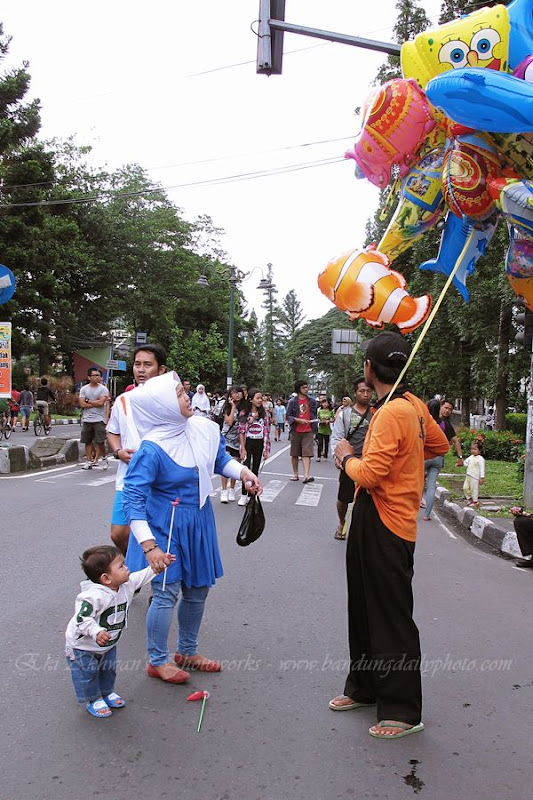
A street vendor offering colorful balloons, a mom and a child. What's going to happen next?
Photo taken at Dago street on the Car-Free Day last Sunday (18/12/2011).

Thursday, August 18, 2011

Brass Music


A number of young people playing brass musical instruments on the road side in front of SMA Negeri 1 (State Senior Hight School No 1) during the Car-Free Day.

As I said before, Car-Free Day is held every Sunday morning along Dago street. During the event, the street is freed from any motor vehicles so that citizens could walk, exercise, and/or simply enjoy the various attractions offered by their fellow citizens.

Photo by Alda Agustine, a Bandung Daily Photo contributor.

Wednesday, August 3, 2011

A Fun Attraction


At Bandung Car-Free Day, you can find a lot of different fun attractions offered by individuals, groups, and members of the city's numerous creative communities. Here's one of them that Sudarmanto Edris, a Bandung Daily Photo contributor, captured last Sunday: A number of young people (students?) put on cardboard boxes to cover their heads and hand in hand they walked together along the street.

Can you read the letters written on the boxes?

Saturday, July 30, 2011

Photographers' Outdoor Gallery


A number of young and talented photographers displaying their works at Dago Street on Bandung Car-Free Day. They said that they displayed their works there so that people would take notice of their works.

Car-Free Day is held every Sunday morning from 6 to 10 a.m. along the upper part of Dago Street from Cikapayang junction in the south to Simpang Dago in the north. During this time, this part of the street is freed from cars and motor vehicles so that the citizens can use it to exercise or simply stroll and relax while enjoying a lot of different attractions offered by their fellow citizens.

Photo by Myke Jeanneta, a Bandung Daily Photo contributor.

Thursday, November 4, 2010

Colorful Glasses


Colorful giant decorative glasses at The Valley, a restaurant at the top of the hills of the Dago area in the north of Bandung. I think they add a nice touch to the spacious and cozy interior.

Monday, August 30, 2010

Dago Tea House Open Air Theater


This is the open air theater of the West Java Cultural Park, popularly known as Dago Thee Huis (Dago Tea House).

The West Java Cultural Park is located in the northern hills of Bandung's Dago area in what used to be a tea plantation and a club house where the Dutch planters enjoyed afternoon tea in the colonial time, thus the popular name Dago Thee Huis (Dago Tea House).

This cultural park has an indoor theater and outdoor theater (pictured above), where traditional Sundanese performing arts are regularly performed, a park, arts shops, and a restaurant where visitors can enjoy traditional Sundanese cuisines.

Tuesday, August 24, 2010

A Glimpse of Jalan Dago


Running north to south, Jalan Dago (now renamed Jalan Ir. H. Djuanda) is one of the longest and most historic streets in Bandung and one that's most celebrated.

Lined up with tall Damar Trees (Agathis Damara), a species of tree that is originated from the islands of Maluku and the Philippines and is considered in vulnerable status, Jalan Dago used to be an idylic street that connected the tea, coffee, and quinine warehouses on Jalan Merdeka in what is now the City Hall in the south and the plantations in the north. Only wealthy Dutch Preanger Planters used to have their villas and houses built along this street. That's how the street gained its prestige.

Over the years, especially during the period of rapid development of the city in the late 1980's through the late 1990's, the street gradually turned into a commercial area. Many of the historic and beautiful residences were - sadly - torn down or made over and replaced by newer buildings that are more suitable for business purposes. A lot of star hotels, restaurants, distros, and factory outlets (FO) have since sprung up along the street. Now it is no longer an idylic street where people could have a leisurely afternoon stoll, but an often-congested busy thoroughfare with a lot of business activities. Thanks to its greenery and prestigious reputation, however, the street remains a favorite place for many to hangout and wander, though no longer for leasure but for the shopping and dining pleasures it offers.

Sunday, November 16, 2008

Bandung Emerging Creative City


Bandung may not be perfect as a city. Despite its many flaws, however, it is a vibrant and lovable city; and one of the many things that its residents as well as visitors love about it is its creative atmosphere.

Bandung is home to some of Indonesia's top art and design schools, e.g. Bandung Institute of Technology's School of Art and Design, STSI (Indonesia's Academy of Art), to name but a few. Many of Indoesia's top artists, actors, actresses, and singers and music groups are also from this city. In addition to this, Bandung is also considered by many as Indonesia's fashion capital and trend-setter. What happens in this city in the ways of art, culture, design, fashion, and lifestyle is fast spreading to other parts of Indonesia and beyond.

As a recognition for its contribution to Indonesia's and the region's development of creative industry, Bandung was recently named as one of the two pilot project cities for the development of creative-industry-based economy in East Asia by an international conference of cities with creative-industry economy. This sculpture on the junction of Jalan Dipati Ukur (Dipati Ukur Street) and Jalan Ir. H. Juanda at Dago is one of the markers installed throughout the city to celebrate Bandung as an emerging creative city.