Showing posts with label Musical Instruments. Show all posts

Saturday, June 30, 2012

Bedug and Kentongan

Top picture: The bedug at Al-Hikam Mosque in Cililin in West Bandung.

Bedung is a musical instrument that is traditionally used as part of the gamelan ensemble. It is basically a double-barreled drum made of wood with buffalo skin/leather covering both ends. Its shape is similar to the kendang but is generally much larger in size. Because of this, the sound it produces is deeper and duller. Another feature that makes it different from the kendang is that it is typically placed on a rack (see picture above) and played with a mallet.

On Java island bedung is also traditionally used in mosques to mark the times of the daily prayers and is sounded before the adhan (call to prayer). The tradition probably began in the old days before the loud speaker was invented. The sound of the bedug could reach farther than the voice of the muezzin (the caller to prayer). This function has long been replaced by the loud speaker. However, many mosques still retain and use the bedug as a matter of tradition.


In addition to the bedug, many mosques on Java island traditionally also use the kentongan or slit drum to mark prayer times and help call Muslims to prayers.

The use of bedug and kentongan in mosques is just another example of many ingenuous adaptations and localization that Indonesians have been making in absorbing foreign cultural and religious elements to suit their own environments and needs.


Sunday, April 29, 2012

BDG Mooi!


A young graffiti artist (graffitist?) at work at BDG Mooi! Old Bandung Festival held in Kota Baru Parahiyangan in Padalarang, West Bandung, yesterday and today (April 28 - 29, 2012).

The graffiti contest was one of the events that make up the festival that was held to showcase the charm of the old Bandung. Other events include music performances, carnivals, food bazaar, and exhibitions by different 'Old Time Communities' (Komunitas Djadoel) -- communities of collectors of  vintage and not-so-vintage items from cars to radios and cameras to memorabilia from the old days.

Here are some of the things I saw at the exhibition:

Old typewriter, old movie camera, some old brass musical instruments, a gramophone, an original copy (I don't know what it means) of Stradivarius violin, etc.

I'll show you some more pictures in the next few days.

Monday, March 12, 2012

The Kacapi


A young man playing the kacapi (or kecapi) on the pavement of Dago Street one Sunday morning some time ago. He is the member of the same group that plays the cilempung in the story that I posted yesterday.

Kecapi is a traditional Sundanese string musical instrument of the zither family. If you want to know how it is played and what kind of sound and music it produces you can check it here.

Sunday, March 11, 2012

The Cilempung


A young man playing the cilempung.

Cilempung is a traditional Sundanese bamboo musical instrument. If you want to know how it is played and what kind of sound it produces, you can go to Bandung Daily Photo's sister blog Bandung Daily Video and check it out.

Although both are Sundanse traditional musical instruments and the names are nearly the same, cilempung should be differentiated from celempung. The former is a percussion type of instrument, the latter is a string musical instrument. And while the former is made entirely from Bandung bamboo, the latter is made of wood and strings.

Saturday, December 31, 2011

New Year's Trumpets


Colorful trumpets of different shapes and sizes are the staple of New Year's celebration here. Made from paper with - I must say - remarkable craftsmanship, they have already been offered for sale on the streets since a few days ago.

As anywhere else in the world, tonight revelers will get together on the streets and in many other public places here to celebrate the coming of the new year. Trumpets like these are what many of them would bring to help them in the noise-making hullabaloo typical in new year's celebration.

Being a person who doesn't like crowds and noise, I would just be celebrating it at home, having a barbecue with family and friends and then some reflective moments on my own about the year that has passed and the resolutions for the year ahead.

Happy New Year, everyone!

Thursday, August 18, 2011

Brass Music


A number of young people playing brass musical instruments on the road side in front of SMA Negeri 1 (State Senior Hight School No 1) during the Car-Free Day.

As I said before, Car-Free Day is held every Sunday morning along Dago street. During the event, the street is freed from any motor vehicles so that citizens could walk, exercise, and/or simply enjoy the various attractions offered by their fellow citizens.

Photo by Alda Agustine, a Bandung Daily Photo contributor.

Saturday, January 15, 2011

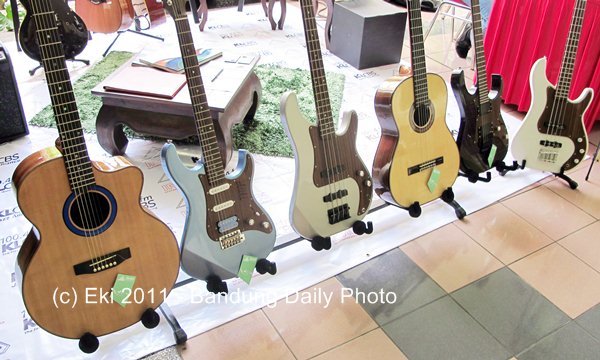
Handcrafted Guitars


These handcrafted guitars are locally made. They are made in Bandung. The company that makes them is called Secco. It makes electric as well as accoustic guitars.

The accoustic guitars in the bottom photo are made of mahogany, spruce, and rose wood.

Monday, October 4, 2010

Karinding


This boy is playing the karinding, a traditional Sundanese musical intrument made of bamboo.

The karinding is a percussion instrument. It is played by puting it in between the lips and shaking it with the fingers to produce a rhythmical vibration.

There are two types of karinding: those made of the midrib of kawung (arenga pinnata) palm leaves and those made of bamboo. The former is said to have originated from the southeast of West Javanese area of Tasikmalaya, and the latter from Cililin (an area in the southwest of Bandung) and Limbangan, Garut (about 65 kilometers to the southeast of Bandung). In terms of shape, they are also slightly different. The former is shorter and is said to have initially been made by men, while the latter is longer and made by women. Such attribution is thought to have something to do with the fact that the shorter one (the 'kawung', male, karinding) can easily be stowed in a man's tobacco walet and the longer one (the bamboo, female, karinding) can be slipped into a woman's hair (and thus also functions as a hairpin).

The karinding is not just a musical intrument. In the agrarian culture of the Sundanese people where rice growing and cultivation occupies a central importance, the low decibel sounds that it produces have traditionally been believed and proven to be a very effective means of pest control.

To see how it is played and hear its sounds, here is a You Tube video that I borrowed from TejoFilm:


The karinding exhibition and demo was part the 4th Bambu Nusantara World Music Festival that was held this weekend in Bandung.

Sunday, October 25, 2009

Sambasunda


It's not easy to do stage photography if you can't get close to the stage or don't have the right equipment. But I was happy doing this one with my pocket camera (my other cameras being out of batteries) and from a position that's not close enough to get good photographs. The music was simply great and electrifying. So even when I could not get decent pictures of this group's stage performance, I was just happy being there to listen to their music.

This is Sambasunda performing at last week's Bambu Nusantara World Music Festival. Sambasunda is a Bandung-based group of creative contemporary musicians whose unique musical compositions and performances have won them a number of worldwide acclaims. Their music is modern but deeply rooted in the rich varieties of Indonesian traditional musical traditions.

The group was established in 1990 with the name PRAWA. In 1997, the name was changed to CBMW. The current name - Samba Sunda - was adopted in 1998 when they launched their first album "Rhythmical Sundanese People" of which "Sambasunda" was one of the songs.

Contrary to what many people think about the name, Sambasunda has nothing to do with the Latin music of Samba. Sambasunda is a combination of "samba", a Cirebonese dialect word that means a pre-puberty teenager, and Sunda, the name of an Indonesian ethnic unit, the native population of the western part of the Java island.

I'll upload the video of their performance later at my other blog Bandung Daily Video.

Friday, June 5, 2009

Sundanese Rebab


Rebab is a two or three string musical instrument that is believed to have originated from the Middle East. It was introduced into the Indonesian archipelago by Moslem traders at about the 10th century CE or about the same time as Islam was introduced into the archipelago. Since then it has been adopted and adapted into the existing local musical ensamble of gamelan.

As you can see from the picture, the Sundanese (West Javanese) rebab - like that of Javanese - is shaped like a heart, has two strings, and two elongated tuning pegs at the top. The strings are usually made of copper. The heart-shaped body is made of wood and covered with a thin layer of membrane made of buffalo skin, intestine, or bladder. The elongated tuning pegs are significantly longer than its Asian siblings.

In a gamelan ensemble, rebab plays the role of the elaborating instrument that gives ornaments to the basic melody. As such, it can be played relatively freer from the scales that other instruments in the ensemble have to follow.

Wednesday, March 4, 2009

West Javanese Cultural Heritage: The Angklung

In addition to cultural performances, Saung Angklung Udjo or SAU (see my post yesterday) also has a sizeable angklung production workshop where visitors can see for themselves how the angklung is made and even learn how to make it themselves.


To learn more about angklung, how it is made, and other pertinent information, you can read this Wikipedia article and/or visit the Angklung Web Institute site.

Although the angklung can theoretically be made from any bamboo, it is best made from two particular types of bamboo, i.e. the black bamboo (the Sundanese people call it "awi wulung") like the one in the bottom photo and the white bamboo or "awi temen".

Tuesday, March 3, 2009

My World: Saung Angklung Udjo (SAU)


The above photo is of Angklung Jaipong dance, one of the art and cultural performances staged at Saung Angklung Udjo (Udjo's Angklung House).

Among many performing art groups and houses in Bandung, Saung Angklung Ujdo (or SAU for short) is probably unique in that it is professionally managed and stages performances of a wide array of Sundanese (West Javanese) arts on the daily basis. Established in 1966 by the late Udjo Ngalagena or Mang Udjo and his wife Uum Sumiati, SAU takes pride in its vision and mission not only as a place where Sundanese arts are performed, but also as a living art laboratory and an institution that strive to preserve the Sundanese cultural heritage and provide community-based art education.


The word "angklung" that makes up its name indicates SAU's specialty in this kind of bamboo musical intrument. Angklung is a Sundanese (West Javanese) traditional musical instrument made of bamboo. Angklung performances are the main stapple of SAU's menu. Throughout the two hour daily performances, the angklung and Sundanese bamboo music makes up five out of ten performances given. In one of them, the audience is given a chance to play angklung together as an orchestra with the guidance of an expert teacher. Please check my other blog BANDUNG DAILY VIDEO at some later time to hear the music and see how angklung is played.

Other performances offered at SAU include a Wayang Golek demonstration, Tari Topeng Cirebon (Cirebonese Mask Dance), and Helaran (festive celebration of important occasions in the Sundanese society), and Tari Merak (Peacock Dance).

SAU is located on Jalan Padasuka 118 in the east of Bandung.


This post is BANDUNG DAILY PHOTO's participation in My World Tuesday. Please click the link to check other posts from the participating blogs from around the world.

Sunday, February 8, 2009

Sundanese "Kendang"


This is a picture of "Kendang", the traditional Sundanese drum. Like any drums, it is a membraphonic percussion musical instrument.

Sundanese "kendangs" are classified and named according to their sizes. The largest of them is called "kendang gede" (the large drum), then there is "kendang leutik" (the smaller drum), and "katipung" (the smallest drum).

If you look at the picture, one side of the Sundanese drum has a wider surface than the other. The part with the wider surface is called "bem" and the one with the narrower surface is called "kempyang".

A standard "kendang" is usually about 60 - 70 centimeters (23.6 - 27.5 inches) long, with the diameter of about 20 centimeters at the "bem" side, 25 centimeters in the middle, and 15 centimeters at the "kempyang" side.

"Kendang" is usually played in a set, that is the larger "kendang" and its smaller "siblings". It can be played to accompany a dance (for example in "Jaipongan"), in a combination with other musical instruments like in "degung" or even in an ensemble of their own, which is called "rampak kendang".

To see how this musical instrument is played in a "rampak" (ensemble), please check out this 9 minute 24 second youtube video presentation courtesy of kocin. This "rampak kendang" performance was made by KABUMI, the performing art group of the Indonesia University of Education Bandung (my Alma matter) who was performing in Tokyo quite a while ago. (Note: The video includes an opening speech in Japanese by the host of the program. The actual performance starts at minute 1:15.)