Showing posts with label Photo. Show all posts

Wednesday, July 1, 2009

Theme Day: Kosong


Kosong is an Indonesian word for empty, which happens to be this month's theme at CDPB (City Daily Photo Blog).

Photographically, I think it is impossible to visualize emptiness, for even in an empty space, there must be something, a few things, visible or invisible. In a photograph, one of those things is the frame.

So, visualizing emptiness is about interpretations. And this is mine. An empty bench in an office waiting room. Is it a good sign (that every visitor has been served timely that one one has to wait)? Or a bad one (that nobody wants to deal with that office)?

Happy Theme Day, everyone!

Click here to view thumbnails for all participants

Friday, October 17, 2008

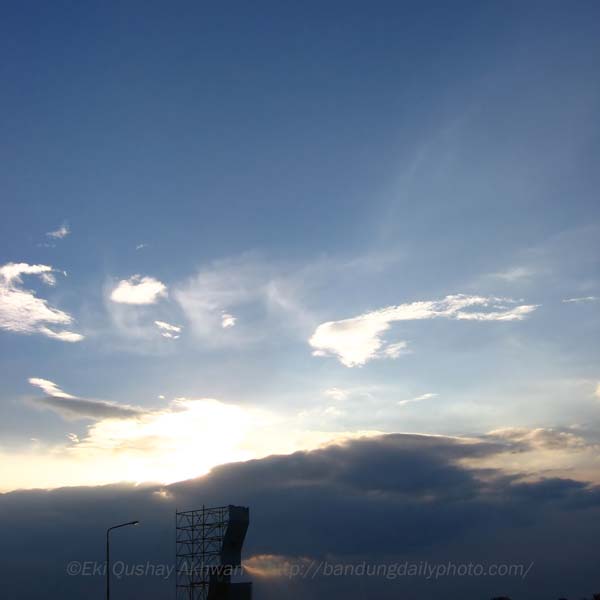
Skywatch Friday Post: Bandung's October Late Afternoon Sky


I took this photo of Bandung's October brilliant late afternoon sky last Monday (October 13, 2008) at about 5:00 PM.

The almost shillouette structure at the bottom of the photo is the rock climbing tower at the Faculty of Sports Education campus of the Indonesia University of Education (Universitas Pendidikan Indonesia) in the north of Bandung.

For your information, October is the transition period between the dry season (summer) and the rainy season here. The seasonal change period like this, in my experience, is the time when the sky usually looks brilliant and is "populated" by interesting cloud patterns.

To see other participants' photos of the Skywatch Friday, follow this link.

Have a great a weekend, everyone!

Sunday, September 7, 2008

The Home Story of Adenium, Jambu Batu, and Kedongdong

H0ME 2

Text and pictures by Eki Qushay Akhwan

Thank God, it's weekend! Time for quieter moments at home. Time to be with family and loved ones. Time to take care of my plants and garden, which I have been neglecting for sometime.

I know, today's photos would not be qualified to be a City Daily Photo post, but I can't help it. I need to take a break from journaling Bandung, just for today.

I have quite a number of plants in my small front and back yard gardens. The pink-flowered adenium at the top photo is one of my favorite flowering plants. Then there are also a couple of fruit trees which I grow in large pots. The "jambu batu" (psidium guajava) or guava is fruiting and I think will be ready for picking in a couple of weeks' time. This season's yield looks better than last year's when some sort of leave flea attacked it and almost killed it.

Jambu Batu Copyrights Eki Akhwan
"Jambu Batu" (guava)

The "kedongdong" (spundias dulcis) - a fruit tree that can only be found in Southeast Asia - is also fruiting generously this season, and I think the fruits will also be ready for picking in a couple of weeks' time. So, I can expect to have an abundance of tropical fruit supply from my own garden this coming weeks. :)

Kedongdong Copyrights Eki Akhwan
"Kedongdong"

Now that we are talking about fruits, Bandung's (and in general the western parts of Indonesia's) fruit season usually takes place between September and January. During this period, different kinds of tropical fruits are in season one after another. If you are a tropical fruit lover, it's the best time to go and hunt for them; that is, if you don't mind the rainy season, which normally takes place at the same time as the fruit season.

Have a good weekend, everybody.

Thursday, September 4, 2008

Book Lovers' Heaven

BOOK STORE

Text and picture by Eki Qushay Akhwan

For book lovers, a library or a book store of any kinds is their heaven.

You might wonder if Bandung's people love books. Well, frankly speaking, I don't have the number to tell you with a great degree of certainty that they do (or don't). But as a book lover myself, I can tell you that a book store like the one in the above photo seems to be a favorite place to many people here, especially on weekends. They don't necessarily buy books there, but they do browse and read, which I think is good.

There are a good number of big book stores in Bandung, but there aren't many big players. These big book stores belong to the big players in Indonesia's book markets. Two chains are particularly dominant: Gramedia and Gunung Agung. You can go to any big cities in Indonesia and, when it comes to finding a good book store, chances are you'd find these two names in their major shopping malls and supermarkets. I think the situation is similar to the US where, to my experience, two particular "big guys" can be found in almost any cities.

With their "gigantic" size, these two book store chains (Gramedia and Gunung Agung) have their own advantage: They carry more books and titles (which is important for customers who don't want to go from store to store just to find what they need/want).

Anyway, as I said in one of my previous posts, Bandung also has a number of great petite book stores. These smaller book stores usually carry books in specialized topics and interests (cultural studies, religions, engineering, etc.). Some of them are even designed more as a home's cozy library or reading room than a book store. Then, as I also mentioned in a couple of my previous posts, there are also a number of street-side (used) book and magazine vendors, and at least one special book market where small book stores are gathered in one place (I'll cover that next time).

So, do Bandung people love books? I think they do. Otherwise these book stores and markets would not have thrived.

Tuesday, September 2, 2008

Umbrella Taxi Kids

UMBRELLA TAXI

Text and picture by Eki Qushay Akhwan

Being caught in the rain can be annoying if you are not prepared with an umbrella. But that does not need to happen in Bandung. For a small fee, these children will be more than happy to lend their umbreallas and escort you to your car or a near by bus stop. Locals call these children with umbrellas "ojeg payung" or umbrella taxi.

I took this photo in front of a book store on Purnawarman Street, Bandung.


Note about the photograph:
A photographer's quick reaction and alertness are very important in sreet photography. An interesting moment sometimes happens only in a split second. I had my digital point and shoot camera out when this scene presented itself, but I was not quite prepared to capture it. I tried my luck anyway. I think I did not quite miss the moment, but the setting and the shutter lag*) of my point and shoot camera made this picture a bit blurred and the highlight areas overexposed.

*) Shutter lag: The delay between the actual moment the camera shutter is pressed and the time the photograph is recorded. Point and shoot pocket digital cameras are especially prone to this phenomenon because of the time it takes for these cameras to charge the CCD (Charge-Coupled Device) and the slow transmission rate of the data to the circuitry of the camera for processing and storage.

Photo basic technical data:
Equipment: Canon PowerShot A510, 3.2 megapixel point and shoot camera
Shutter speed: 1/60 sec.
Aperture: F/2.6
Metering mode: Pattern

Saturday, August 30, 2008

Bandung Urban Scenes - Exploring Urban Photography #2

16 Agustus 2008 NIKON D70 046BBW

Text and picture Eki Qushay Akhwan

As I Was saying yesterday, urban photography is esentially about finding "order" in what looks like a chaotic realities of urban life. Patterns are one thing that we can look for. Another thing that we can look for to comprehend the chaos is the human elements - their activities, their day to day struggles in navigating the hustle and bustle of a city, etc. Unlike the geometric or "still life" elements, the human factor tells the story of a city through motions (and emotions).

The focus on the human element is, I think, where urban photography intersects with street photography.

I took the scene in the above photo on Jalan Suniaraja (Suniaraja Street), Bandung. Three human figures in the photo depict motions of different kinds symbolic of their stuggles in finding their ways to their uban existence.

Friday, August 29, 2008

Bandung Urban Scenes - Exploring Urban Photography #1

Urban photo 1

Text and picture by Eki Qushay Akhwan

Urban environments may look visually chaotic. But to the discerning eyes of photographers and visual artists, this chaos is just a facade beneath which are hidden an infinite number of interesting elements ready to be discovered if only one can pay enough attention to the details and/or rhythms that make up that chaos. This, I think, what urban photography essentially is: an attempt to discover "order" in what looks like incomprehensible and chaotic realities.

In exploring urban photography, a genre of photography which is generally still categorized as a subform of documentary and/or street photography, a photographer needs to be creative and have a daring attitude to see the realities around them in different ways. One way to do it is to look for patterns, like what I did with this photograph, which I took at BEC (Bandung Electronic Center) parking lot a couple of days ago.

Thursday, August 28, 2008

Bandung Street Phenomenon: The "Kaki Lima"

KIOS JONGKO

Text and picture by Eki Qushay Akhwan

"Kaki lima" - which literally translates as "five feet" - is the popular and accepted Indonesian term for street vendors that sell things on a cart like this. I don't know where this term originated. But if you take a look at the above photo carefully, I think it makes sense. The cart has three wheels. Add these to the owner's two feet, and that makes five; thus the phrase "five feet".

Kaki lima is quite an urban phenomenon in Indonesian cities. You can find them almost anywhere. They sell different kinds of things: snacks, drinks, cigarettes, soaps, detergent, shampoo, over-the-counter medicines, etc. They are like a mini convenient store. "Convenient" is the key word here as they can usually be found within a walking distance of any neighborhoods and open around the clock and seven days a week (24/7).

While the term "kaki lima" may have originated from this kind of kiosk cart, the term is now also used for different kinds of street vendors - with or without the carts.

Kaki lima is both an important mover of our cities' economy and a headache. They often occupy (invade?) the sidewalks and block pedestrians' access to the sidewalks, forcing them to walk on the street and putting them at risk of being hit by motorists. Their unorganized sprawl, I think, is also a sore to the eyes.

Wednesday, August 27, 2008

City of People: Bandung Skateboarders

BANDUNG SKATEBOARDERS

Text and pictures by Eki Qushay Akhwan

Did you know that during its earliest development skateboarding used to be called "sidewalk surfing"?

It did. And that nick name had to do with its origin. It is said that the idea of skateboarding was born when some Californian surfers could not go surfing because the wind was flat and there were no waves; hence was the idea to "surf" on land. That was in the late 1940's.

Now skateboarding has become a worldwide phenomenon, a kind of sport and recreational activity loved by young people from nearly every corner of the world. I have to underline the word "young" because survey statistics shows that 85 percent of its fans are young people under the age of 18. It is also characteristically a male sport (or recreational activity) as nearly three quarters of its practitioners are male.

BANDUNG SKATEBOARDERS 2

Skateboarders used to be described as a rebellious subculture group whose image was associated with punk and a reckless lifestyle. This image, however, has changed now as its fans have become more diverse.

I took the above photos at a recent skateboarding exhibition on Braga Steet where this group of Bandung skateboarders - experienced as well as novice - demonstrated their ability to make different acrobatic tricks. Skateboarders have different terms for the different tricks they perform, such as "Ollie" (or no hand aerial) where the skateboarder "flies" in the air without holding on to the board; "kickflip" (or "heelflip"?) where the skateboarder kicks the board so that it flips 380 degrees along the board's long axis; and "pop-shove it" where the skateboarder plays with the skateboard while skateboarding. I'm sure they have a few other tricks, but that's all I can remember.

I have to admit here that it was quite difficult to take photos of their actions because the street was packed with spectators and there were no lines that separated them from the action. Street and action photography do have their own challenges. However, it is from events like this that I learn to hone my street and action photography skills.

Tuesday, August 26, 2008

What's Success?

SUCCESS EQUALS WHAT

Text and picture by Eki Qushay Akhwan

What's success?

According to this billboard, the equation of succes is this: Math + English; and that means the school whose name is advertised there. Does it make sense?

Perhaps.

English, although not a language with the largerst number of speakers, is the most widely spoken language worldwide. Logically, one who can speak English has access to all the information there is to succeed and compete anywhere.

As for math, it's the ultimate language of science.

Speaking of science, Indonesians, I think, can be proud of the achievements of their students and scholars. This year, Indonesian high school students ranked 36 out of 97countries participating at the recent International Mathematics Olympics held in Spain, with one silver and two bronze medals plus an honorable mention title.

At the International Biology Olympics, Indonesian team received two silver and two bronze medals.

In Chemistry, our team performed even better, winning one gold, one silver, and one bronze medals at the recent International Chemistry Olympics held in Hungaria.

The best science olympics achievements of our high school students yet, however, is in physics. Indonesian International Physics Olympics team has consistently won a respectable place for many years now. This year, for example, it won two gold, two silver, and one bronze medals at the 2008 International Physics Olympics held in Hanoi, Vietnam, in July.

Monday, August 25, 2008

Creativity on The Steet

CREATIVITY ON THE STREET

Text and picture by Eki Qushay Akhwan

I believe this is what's called "installation art". These rounded-edge geometric shapes were erected (or installed) temporarily on Diponegoro Street in Bandung a couple of weeks ago as part of the 2008 HELAR Fest.

Just a note to my friends and readers:
I'll be very busy this week. So basically I will temporarily set this blog on an "automatic pilot" mode. ;) I'll still be posting one photo a day as I am supposed to do with this Daily Photo blog, but most probably with shorter commentaries. Thank you very much for your visits and comments. I'll be returning your visits soon.

Sunday, August 24, 2008

City of People: Women Entrepreneur and Gasibu Sunday Market

WOMAN ENTREPRENEUR

Text and picture by Eki Qushay Akhwan

I don't know exactly how and when it began, but every Sunday morning the Gasibu Square (a large open space/field in front of Gedung Sate, West Java Governor's Office Mansion in Bandung) turned into a market place.

As far as I can remember it, people used to come here only to exercise on Sunday morning. I guess that's how the Sunday market began. When vendors and people with entrepreneurial spirit noticed that a large number of people flocked here every Sunday morning, the saw a potentially lucrative business opportunity and began to open their beverage and light food stalls for those Sunday "sporters". What began small eventually attracted like-minded others. Now vendors at the Gasibu Sunday market do not only offer beverages and food but also a lot of other stuff: clothes, watches, sunglasses, fruit and vegetables, household wares, handicrafts, and even arts and pets. It's like a Supermarket (with large S) that only happens once a week. Gone are the leisurely joggers and walkers who used to come here to exercise. There is simply not enough space left now on Sunday for people who come here to exercise because all the lots are now occupied by vendors of different kinds. But many people with sports attires still love coming here on Sunday, not to exercise but to stroll and enjoy the interesting sights, sounds, and smells of what locals call "Pasar Kaget" or surprise market.

The market usually ends just before mid-day. The lady entrepreneur you see at the photo was biking home with her stuff after Sunday market was closed.

You could see more photos of Gasibu Sunday market here.

Note:
The word Gasibu is probably derived from the word gasebo and indicates what this place used to be in the old days.

Saturday, August 23, 2008

Colors of The Rain - A Global Warming Symptom?

3 Agustus 2008 CANON A 510 011


Text and picture by Eki Qushay Akhwan

There have been quite a number of weather surprises here lately. August is supposed to be the height of the dry season in Bandung, but there have been a few days where rains fall unexpectedly. While they are a welcome respite from the dry spell, they are a bit surprising nonetheless.

I took this photo earlier in the month on Jalan Wastukancana, Bandung. It was sunny when I left home for the downtown. Some 30 minutes later, the rain began to fall. As I was on my motorcycle, I had to stop. And while I was waiting for the rain to stop, a couple of kids came into sight with their colorful umbrellas. They were playing in the rain. So I took out my camera and began shooting. This was one of the snapped photos.

Weather irregularity is probably a symptom of global warming. Here is what wikipedia says about it.

Friday, August 22, 2008

City of People: Street Photographers and The Freedom of Expression

US

Text and pictures by © Eki Qushay Akhwan

Just a reflection on ourselves. We, photographers or photography enthusiasts, not all probably, but undoubtedly many of us, are infinitely proud of our gadgets as you can see in these photos.

"Hey, what camera do you use?"
"How big is your thing?"
"Look what I got ...!"
"Hmmm ... that photo I took was a bit disappointing ..."

I don't think I'm one of those photography enthusiasts who are too fascinated with gadgets (I could have, but not anymore). I do have a number of cameras and quite a few lenses. But they were from the old days when I was still very much fascinated with gadgets. Now I just take pictures and don't really care very much about what camera I use. Most of the time I take photos with my 3.2 megapixel point and shoot camera, a Canon Powershot A510, which I always have with me because it's light and easy to carry and inconspicuous in public places. Only occasionaly do I bring my DSLR camera, a NIKON D70, which I bought in 2005, usually when I really intend to hunt for photos.

As you have probably seen from my street photographs, Bandung is probably and quite arguably one of a few great places to do street photography. I've been to (and lived in) quite a number of cities in the world. Nowhere did I feel so much at ease about taking photographs in public places than Bandung. This could be a subjective feeling, I know. I've lived here most of my life, even though I was not born here. But then, there could be a number of other factors that make street photography so much more easier to do in Bandung. People here are very friendly and are not usually shy with stangers. The streets, chaotic though they may look at times, are very alive and bustling with a lot of things: vendors, jay walkers, shoppers, ...

We may not be as afluent as people who live in more developed countries, but I sense the people are genuinely much happier here, freer too.

I once had a bad experience taking pictures in the United States (I studied there for two years). One sunny, summer afternoon, I was taking pictures on the street. Minding people's privacy, which I knew was highly valued by Americans, I only took photos of buildings and architecture. Just when I was busy doing it, a police car stopped right in front of me, and the officers began to interrogate me. Apparently, a good citizen, seeing a stranger-looking guy taking pictures of buildings, had called the police. He/she might have thought that I was a terrorist planning a terror attact of some sort with my photography. Only with difficulty, and after a few phone calls to my university's international students' office, did I convince the officers that I was a legal resident and that I was not a bad guy. Still, I think, they keep a record of my identity.

It feels good to be free in a free country.

Tuesday, August 19, 2008

City of People: Sunglasses Galore - Exploring Street Photography #3

Sunglasses Galore

Text and picture by © Eki Qushay Akhwan

Did you know that experiments with tinted lenses that are now used in sunglasses began as early as in the 18th century? Did you know that sunglasses (or tinted lenses) were once believed to be able to correct vision impairment, and even cure diseases such as syphilis? If you didn't then you can find the answers here.

For all the interesting and incredulous facts about sunglasses, they are now part of modern artifacts that many people love and use (or wear); not as a cure to a kind of STD disease as they were once believed to be, but more as a fashion statement and/or eye protector against the harmful ultraviolet (UV) rays.

According to the same source I linked above, the first inexpensive mass-produced sunglasses were first introduced in the United States by a paticular Sam Foster in 1929. He found a ready market on the sunny beaches of the Atlantic City, New Jersey.

Anyway, I took the photo of the sunglasses vendor above on the steets of Bandung as part of my exploration of street photography themes.

In the previous posts here and here, I already wrote what street photography was essentially about. Now, allow me to write a bit about the technique.

As street photography is about taking photos of candid moments at public places without interference with the subjects and/or the unfolding event, being stealthy and inconspicuous is important for the photographer. Otherwise, you would disturb the subject's (and the unfolding event's) "candid equlibrium". This is a challenge that is not easy to meet, especially when we have to get close to the subject. On the one hand, the subjects would usually feel jittery, uncomfortable of an approaching camera on a public space. They would probably start acting unnaturally or become suspicious of the camera's presence, and this is a failure in street photography. On the other hand, the photographer him/herself would would probably feel shy and inhibited about approaching a stranger on a public space.

To overcome this, we could probably start with telephoto lens to avoid getting to close to the subjects. But this can't be our mode of operation all the time as photos taken with long lenses are not the same as those taken with shorter ones. Therefore, after a while you should try to be inconspicuous in other ways. A method that was practiced by practiced by Henri Cartier-Bresson was to make the camera invisible by wrapping a large piece of cloth around it and by "blending-in" with the subjects, e.g. wear something that makes you "invisible", act like you were one of them, and "befriend" them if necessary; take your time to get familiar with them and let them get familiar with you and don't rush into taking photos until your subjects feel comfortable with your presence and the camera.

I hope this tip is useful to you.

Sunday, August 17, 2008

City of People: Long Live the Republic - The Story of A Veteran

Text and pictures by Eki Qushay Akhwan

Today, August 17th, sixty three years ago, Indonesia proclaimed its independence. The history about our country's struggle for independence, our flag, and our coat of arms (the quintessential symbols of our existence as a nation state), may be found anywhere else on the internet. So, instead of picturing those symbols, allow me to share with you today the story of an individual; an eye-witness to our struggle for independence and for defending it against the colonial forces that was trying to recapture their former colony and subdue our independence.

Veteran 2

He might be a nobody. He might look like anybody. He's old and fragile. But it was for him and people like him that we now enjoy our independence.

B

His name is Saleh. A simple name. No title. No glittering stars decorating his chest. Only two simple and worn-out medals recognizing the service he had given to his country. He's wearing them proudly today. He's a fragile 78 year old man now. He was barely 15 when Indonesia proclaimed its independence. Yet, when the duty called to defend the young Republic, he unhesitantly raised his arms: ready to give his life to defend his rights, his people's rights, and the rights of all human kinds - freedom!

Veteran 5

I met him today at the Gasibu Square (the field in front of Gedung Sate, Bandung, West Java's governor's office mansion), just after the ceremony commemorating the 63rd anniversary of our proclamation of independence. He's still very much spirited when I asked him to share the story about the battles that took place in Bandung and its surrounding areas to defend the young Republic.

Veteran 4

I hope we will never forget men and women like him who fought for our independence. Our independence did not come as a free gift. We should never take it for granted. It is our turn now to give our best, so that the country that he and many others like him had helped established may prosper and have a dignified place among nations.

Thursday, August 14, 2008

City of People: Exploring Street Photography #1

Friends on the street 3

Friends on the street 4

Text and pictures by Eki Qushay Akhwan

Moments like this, in my opinion, can reveal more about the life of a city than the whole objects contained in it. It is because people are the heart of a city (It's a reiteration of the point I made when I first started my City of People Series).

In photography, this kind of photograph would be categorized as street photography, a genre of photography that focuses on documenting candid moments that happen on public places, such as the streets, markets, parks, beaches, etc.

This kind of photography tries to capture the scenes and moments as they are with no interference whatsoever in the unfolding of the event or with the subject. As such, technically (in the sense of sharpness, etc.), street photography photos often look "imperfect"; but if you look carefully, you can almost feel the purity and the essence of the vision. It's a piece of life fronzen in a frame.

I'll write more about street photography tomorrow.

Wednesday, August 13, 2008

Baby in the Air

BABY IN THE AIR

Text and picture by Eki Qushay Akhwan

It would certainly be horrifying to see a baby in the air. But this is what I see almost everyday on my way to work at the Pasteur Exit of Padaleunyi toll road. This sight never fails to amaze and amuse me. Come rain or shine, the baby has always been there, waving and smiling in the air. So, one day, I deliberately stopped my car and took this picture, so that when it's (or he's) gone, I can still smile and be amused just by looking at this picture.

Tuesday, August 12, 2008

TOBUCIL Creativity and Literacy Club

Tobucil 2

Text and picture by Eki Qushay Akhwan

I came across this curious piece of paper-folding craft entitled "Lafafa Space" at the TOBUCIL tent at BANDUNG KICKFEST 2008, an event which was held as part of the HELAR Fest (Bandung's annual event for creative industry communities).

Tobucil which stands for Toko Buku Kecil (Small Book Store) is not an ordinary book store. It is not just a place that sells books but also a literacy and creativity club. According to its blog (in Indonesian language), this book store has philosophy club, reading club, writing club, and different kinds of handicraft clubs.

I've heard about this place for sometime but have not really got the chance to visit it. I think I'll have to do it soon, so that I can tell you more about it. For now, perhaps you could read this review at The Jakarta Post (Indonesia's largest English newspaper).

Tobucil 1

Monday, August 11, 2008

City of People: Futsal Players

Fultsal Players

Text and picture by Eki Qushay Akhwan

Back to my City of People series.

While Bandung and the Province of West Java in general are well-known for their world class badminton players, e.g. Susi Susanti (1992 Barcelona Olympic Games Gold Medalist), Rexy Mainaky & Ricky Subagja (1996 Atlanta Olympic Games Gold Medalists), Taufik Hidayat (2004 Athens Olympic Games Gold Medalist), it doesn't mean that Bandung people are not as passionate about other kinds sports as they are with badminton. In addition to Badminton, football (US: soccer), and basketball; futsal is a kind of sport that is increasingly becoming more popular in the city. A lot of young people play this sport nowadays. New fields and clubs are significantly growing in numbers as are competitions and championships.

Not being an aficionado of soccer, I did not know much about fulsal. All I know is that it is an indoor version of football/soccer. Unlike football/soccer, however, each team only has five players, one of whom is the goal keeper, and it is played with smaller ball than the ordinary football/soccer. The name fultsal itself comes from Portuguese word futebol de salao or Spanish word fulbol de salon (indoor football).

The young people in the photo above were playing fultsal at an exhebition competition recently held at Jalan Braga (Braga Street), Bandung.