Showing posts with label Landscape Photography. Show all posts

Monday, August 1, 2011

August 2011 Theme Day: Kawah Putih Revisited


Back in August 2008, I posted two stories about Kawah Putih (White Crater): here and here. The pictures shown in those posts were taken during the peak of the dry season and the crater lake looked shallow. I visited the crater again early this year during the wet season when the water was higher and took some more photos. This is one of them. I am sharing it with you today to show you a different view of the lake.

This photo and post is Bandung Daily Photo's participation in this month's CDPB Theme Day: Postcard-worthy. Click here to view thumbnails for all participants

Friday, July 29, 2011

Sunset at Gunung Masigit


Two weeks ago, I went on a short hiking and climbing trip to Gunung Masigit (lit. Mt. Mosque, 2078 meters above sea level), a limestone mountain near Padalarang in West Bandung Regency. The trip was part of a one-day tracking tour of pre-historic Bandung organized by our friends at Mahanagari (I'm going to write a complete story about it later).

It was near sunset when we got to the top, and rainy, which was quite a disappointment because we had wanted to enjoy the beauty of the sunset from there. So, while waiting for the rain to stop, we took shelter in a makeshift hut prepared by some previous climbers. Some twenty minutes later, the rain subsided and the sun began to appear again on the horizon. This is one of the photos I could manage to take from the hut before the rain completely stopped.

This post is Bandung Daily Photo's participation in this week's Skywatch Friday. Please follow the link to check other participating blogs' posts.

Wednesday, July 27, 2011

Saguling Lake


The tranquil water of Saguling amid the backdrop of the blue ridges of Bandung's southern mountain range seen from Cikadu, Sindangkerta, West Bandung Regency.

Saguling is a man-made en-catchment lake made for a hydroelectric power plant dam of the same name. It was built in 1985 and is located on the upstream of the Citarum River about 40 kilometers to the southwest of the city of Bandung at the elevation of about 650 meters above sea level.

The Saguling Dam currently produces 700 megawatts of electricity. The capacity can, however, be increased to 1400 megawatts when required. The dam is part of a system of three dams along the Citarum. The other two, located further downstream, are the Cirata and the Jatiluhur.

This post is Bandung Daily Photo's participation in Watery Wednesday.

Friday, July 10, 2009

Skywatch Friday: Point North


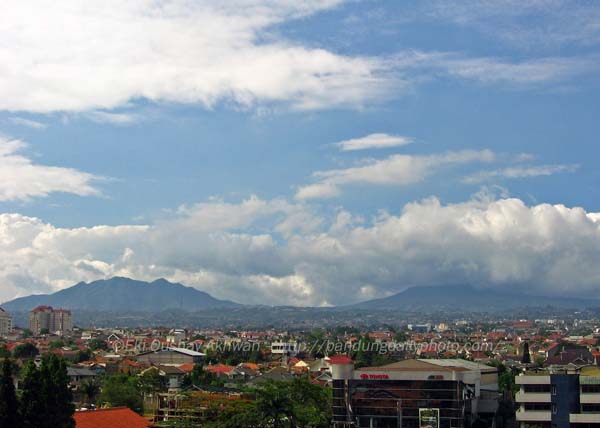
This is the view of Bandung's point north as seen from The Pasupati flyover bridge at the center of the city. The mountain on your left hand side of the picture is Mt. Burangrang (2057 meters/about 6748 feet) and to the right is Mt. Tangkuban Perahu - "the capsized boat mountain" - (2084 meters/about 6837 feet).

Please also visit this week's participants of Skywatch Friday meme here.

Friday, December 19, 2008

Skywatch Friday Post: Sky of Gold


This is what Bandung's sunset looked like yesterday, painted in gold.

We've had glorious sunsets quite a few times this month, and at least twice this week. True, December is the rainy season here, but it doesn't mean that we don't have sunny days at all. It was sunny all day yesterday and was only a bit cloudy in the late afternoon. Perhaps because of this, the sunset was painted in gold.

This is what I know of the clouds and how they might have helped create this glorious illusion of light:

Clouds are formed by a process that's called condensation, a process by which gas and vapor are changed into liquid. Condensation takes place whenever warm air (which, by the way, is normally wetter because it contains more water vapor) meets with cold air. This explains why these clouds were forming - the warm sunny day evaporated a lot of water; the vapor going up then met with the cool air of the high altitude (where Bandung is located) and the cooler air from the surrounding areas.

Now, the clouds, which are virtually "a floating water container", acts like a giant mirror or reflector and prism that reflects the light of the evening sky and distorts it. Hence, the interesting colors of this sunset.

The shillouetted steel and concrete structures in the foreground of the photo, by the way, are what would be (now under construction) the new indoor tennis and badminton stadium of the Indonesia Univesity of Education (UPI).

This post is Bandung Daily Photo's participation in this week's Skywatch Friday meme. Please follow the link to see other participants photos.

Friday, November 28, 2008

Skywatch Friday: Bandung Glorious Late November Sky


November is the rainy season in Bandung and in most parts of Indonesia in general. We had had rain almost everyday in the first three weeks of November. This past few days, however, the sky has been quite clear. Today was particularly sunny and warm and, probably as a result of this, the sunset was astoundingly brilliant amber, blue, violet, and red.

I took this photo at about 6.00 PM today (Friday, 28 November 2008) on my way home from work. This is a straight shot from my 3.2 megapixel pocket digital camera Canon PowerShot A510. I did nothing to enhance this photo in my digital darkroom except for a little cropping to remove some distracting parts and improve the compositional balance of the picture.

The building with the yellow wall on your right side is the newly constructed Al Furqon Mosque of the Indonesia University of Education (Universitas Pendidikan Indonesia), Bandung.

This post is my participation for the Skywatch Friday meme. To see other great photos of the sky posted by the participants of this meme this week, please follow the link.

Wednesday, November 26, 2008

Bandung Countryside # 3: Jakarta - Bandung Train Window View


I took this photo from behind the glass window of Bandung - Jakarta train.

It is believed that when God smiled, "Parahiyangan" (the Sundanse land of West Java) was created.

Monday, November 10, 2008

Black and White Landscape Photography: Crater Trees


These crater trees grow around Kawah Ratu (The Queen Crater) of Mount Tangkuban Parahu about 45 kilometers north of Bandung.

Tangkuban Parahu, which literally means Capsized Boat, is a popular tourist destination in West Java. I'll tell you about the legend behind the name tomorrow as I post another photo of this beautiful crater. If you are a frequent visitor to this blog, you may remember that I have previously posted a distant view picture of this mountain here.

I took this photo with my pocket, 3.2 megapixel camera.

This photo is my participation for the Monocrhome Maniacs meme. Click the link to see other particpants' great black and white photographs.

Tuesday, October 14, 2008

An Aerial View of Bandung # 1


Bandung is a city surrounded by mountains. On this photo of aerial view of the northern part of Bandung, the mountain on your left side is Mt. Burangrang, and on your right side is Mt. Tangkuban Parahu (a name which literally means "capsized boat" in reference to the mountain's shape).

Wednesday, August 20, 2008

Bandung Countryside #2 and The Strawberry Story

morning in bandung 1

Text and pictures by Eki Qushay Akhwan

This is another photo I took at my morning countryside walk with some colleagues recently.

As I said before, Bandung may be a bustling metropolis, but the countrysides surrounding it are still very rural and scenic; better still, they are never far away. This scenic panorama of a village in Cikole area, for example, is located only 17 kilometers (about 10 miles) north of Bandung.

Being located on a highland and surrounded by mountains and volcanoes, Bandung's soil is very fertile. Combine that with the mild and cool climate, what you get is abundance of agriculture produce (I said here, Bandung and West Java in general have the largest and most productive tea plantations in the country). Bandung is a major producer and one of the largest suppliers of vegetables on the island of Java.

Bandung Strawberry


Strawberry, or more precisely garden strawberry (Fragaria X Ananassa), the most common variety of strawberry cultivated worldwide, is the offspring of the accidental cross between North American strawberry (Fragaria Virginiana) whose nice flavor is very well known, and bigger-sized Chilean stawberry (Fragaria Chiloensis). This plant was first cultivated in Europe in the 18th century. There is a large varieties of stawberry cultivated worldwide, but this garden stawberry is supposed to be their Adam and Eve ^_^, including those cultivated in Bandung.

"Strawberry Tourism" (my term) is now very popular in Bandung. A lot of stawberry gardens are now open for the sole purpose of entertaining visitors's curiosity about this non-native plant. In these places you can pick this savory fruit yourselves, then weigh your picks and pay them at the cashier. Prices range from about 20,000 rupiahs (about US$2.2) to 30,000 (about US$ 3.3) per kilogram, depending on size and ripeness.

Saturday, August 16, 2008

Bandung Countryside

Bandung Morning View


Text and picture by Eki Qushay Akhwan

While Bandung is a busy and bustling metropolis (it is the fourth largest city in Indonesia), the countryiside surrounding it is still basically very rural and surprisingly very close.

I took this photo at a village near Cikole, Lembang, some 17 kilometers north of Bandung sometime ago on my morning walk with some colleagues from the office. The best time to have a countryside walk in Bandung is early in the morning like this (about 5:30 a.m.) when the sun barely rises. The beauty of the scenenery covered in thin fog and the cool and fresh morning air, to me, are so inviting.

Saturday, August 9, 2008

Walini Tea Plantation

Ciwalini Tea Plantation

Text and picture by Eki Qushay Akhwan

Located on a high land and surrounded by mountains, Bandung and its surrounding areas have long been known for their ideal climate and fertility for agroindustry. This potential was well exploited by the Dutch to plant commodity crops such as tea, coffee, and quinine.

Huge tea, coffee, and quinine plantations can be found in the north and south of Bandung. Pictured above is Walini tea plantation located near Kawah Putih (White Crater). This plantation is now owned and managed by a state-owned company PT Perkebunan VIII (Persero). In addition to being a productive plantation producing high quality high land tea, this plantation is now also being offered as an agrotourism destination where visitors can have tea walk, horse ride, and other activities. Right in the middle of this plantation, there is also a natural hot water pool where visitors can swim or have a relaxing hot bath in private bathrooms.

Photography tip of the day: Landscape photography #2
Another thing that we can do to improve the impact of our landscape photographs is to place an object of interest in the foreground to create a sense of depth. In the picture above, the tree I placed in the foreground and the path helped create a sense of depth in the landscape.

Friday, August 8, 2008

Negeri di Atas Awan - A Land over the Clouds

080808A

080808B

Text and pictures by Eki Qushay Akhwan

On the way up to Kawah Putih (White Crater), there is a forest clearing right on the side of road where we can see the whole mountain range in the South of Bandung. The view from this high vantage point is so breathtaking, that it's worth stopping by just to sit and enjoy the view. To me, it's also a great place to reflect upon the greatness of nature and of our place in it.

Photography tip of the day: Landscape Photography
I took these pictures with a small point and shoot camera, my faithful Canon Powershot A510. I didn't have much control over the exposure. But even with a point and shoot pocket camera, great landscape photographs can still be made. With landscape photography, one of the things we can do to improve the impact of our photographs is to find a high vantage point which could give you a commanding point of the scene. If you have an SLR camera, which gives you control over the exposure, set the aperture to the smallest (larger f number, e.g. f/11, f/16, f/22) to give a wider/deeper Depth of Field, so that every detail will be sharp and in focus.

Thursday, August 7, 2008

KAWAH PUTIH (The White Crater): The Legend

KAWAH PUTIH 2


Text and picture by Eki Qushay Akhwan

Before being discovered in 1837, the people who lived around Mt. Patuha believed that the mountain top was a sacred place, haunted by the holy spirits of their the their ancestors. They would never venture anywhere near the mountain top's forests. A trespass like that would mean bad luck or even death. They also believed that on certain nights these spirits would have a meeting discussing the security and welfare of their people and the conservation of the forests and the natural recources that supported their livelihood.

The legend had had the beauty of Kawah Putih hidden and the pristine forests surrounding it preseved for centuries until its discovery in 1837.

A note about the color of the water:
Kawah Putih is a crater lake that covers an active (fumarolic) volcano which has been dormant since 1600. As such they water is typically acidic, saturated with volcanic gases, and cloudy with a strong greenish color. (Wikipedia: Crater Lake).

kawah putih 3


Wednesday, August 6, 2008

KAWAH PUTIH - The White Crater

3 Agustus 2008 CANON A 510 101B


Text and picture by Eki Qushay Akhwan

A Singaporean photographer friend, his wife, and their Malaysian friends came to visit this weekend. I took them to Kawah Putih (which literally means White Crater) in the south of Bandung on Sunday.

Kawah Putih is arguably one of the most beautiful crater lakes on the island of Java, and quite probably in the Indonesian archipelago. It is located about 46 kilometers south of Bandung on Patuha mountain (2,434 meters above sea level). The crater was discovered by a Dutch-German botanist and platation estate owner Franz Wilhelm Junghuhn in 1837. According to geologists, this crater lake was created as a result of Mt. Patuha volcanic erruption in the year 1000 - 1200.

More photos and stories about it on tomorrow's post.