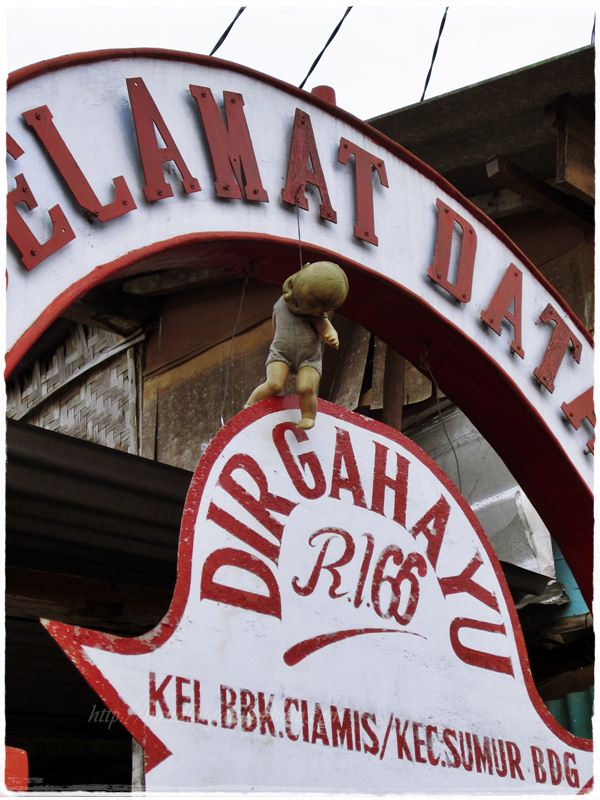
I don't know if it was a prank. It may have been. The message it sends might be ironically funny to some people. But personally, I don't think it is. It's horrific.
A Visual Journal of the City of Bandung and Its Vicinities. A photo a day with insightful and informative commentaries from the capital city of West Java and one of the most fascinating cities in Indonesia.®
Showing posts with label Signs. Show all posts
Friday, May 11, 2012
A Horror Welcome
I don't know if it was a prank. It may have been. The message it sends might be ironically funny to some people. But personally, I don't think it is. It's horrific.
Location:
Jalan Kebon Sirih, Bandung, Indonesia
Thursday, June 30, 2011
Directions
A sign post attached to an "alternating alternates" amber traffic light near Ledeng Bus Terminal indicating the directions to Sapulidi and Imah Seniman (lit. Artist/Artisan House). Both of them are cafes, resorts, and galleries owned and managed by the same company.
Sapulidi is located at Graha Puspa, Cihideung Village, on Sersan Bajuri Street. Imah Seniman is located further away at Cikahuripan village on Kolonel Masturi street.
Many direction signs in this city are what can probably be called "commercial directions" because they don't give you direction to a general area or location, but to a specific commercial venue. I don't know if this is quite common in other cities. I also don't know if this practice is being regulated here.
Saturday, August 7, 2010
Getting Multilingual, Getting International

This multilingual sign/direction at Stasiun Hall (Bandung's main railway station) could very well be among the first in town. Most signs and directions in this city are written in Indonesian (Bahasa Indonesia) and only few of them are written bilingually in English and Indonesian. I think it has been put up only recently. It was not there when I passed the station about two weeks ago.
This multilingual sign is probaly a good sign that the city is getting more international. In the past couple of years, Bandung has indeed been receiving more overseas visitors, easpecially since the opening of direct flights between this city and Singapore and Kuala Lumpur.
Wednesday, September 24, 2008
Reading Signs #2: Language Barrier?
Assuming that you don't understand the words written underneath the sign, can you still make out what the sign means? If you do, then it is a good sign.
By definition, sign is a token that signifies an entity outside itself. There are two kinds of signs: natural and conventional. A natural sign bears a causal relationship between the signified and the signifier, e.g. the image of a lightning for the natural phenomenon of the same. A conventional sign, on the other hand, works on the basis of a convention or agreement made among its users, for example punctuation marks or the (traffic) stop sign. Furthermore, a sign may be both natural and conventional. The example for the this is the no smoking sign.
Sign is not the same as symbol, which is commonly defined as something that represents something else by resemblance, association, or convention. A symbol is usually a tangible representation of something abstract - flag as a symbol of a nation, for example. In this way, language (word) is considered as a symbol rather than a sign because the relationship between the signifier (i.e. the word) and the signified (i.e. the concept) is conventional.
What does the sign in the above photo signify? I'll let you tell, and see if it is a good sign without the words accompanying it.
I took the photograph in the same premises of the one I posted yesterday, i.e. Bandung Electronic Center (BEC).
Tuesday, September 23, 2008
Reading Signs #1: Courtesy or Incompetent Lady Drivers?
Signs tell a lot of things about the society in which they are found. This one I photographed at the parking lot entrance of Bandung Electronic Center (BEC) on Purnawarman street, for example, may look simple and innocent. But if we read it carefully, it actually may not be as simple and innocent as it looks.
On the surface, the message of this sign looks like a courteous and privileged treatment for lady drivers. Underneath this surface, however, this sign also implies that lady drivers are being considered not as competent as their man counterparts. It is therefore both a statement of courteousity and inequality between men and women.

The fact that this sign is written in English may escape the scrutiny of native English speakers who live in a country where English is its first or second language. When read against the fact that English is neither the first language nor second language in Indonesia (read: Bandung, where this sign is located), a different set of conclusions may be drawn. First, we may conclude that there may not be a sufficient equivalence for the term in the Indonesian language (the conclusion of which, of course, is not true as the Indonesian does have a perfect match translation for it). Second, English is considered as a more prestigious language by the owner/management of this mall/business premises in particular, and the society in general. To the dismay of may patriotic and nationalistic Indonesians, this conclusion may be true. English has become a more and more prominent language in our daily life to the detriment of our own national language, Bahasa Indonesia.
As simple as they may look on the surface, signs do tell a lot about the condition of a society. Therefore, beginning today, I'm going to take you on a tour of sign reading in the city where I live: Bandung. This series of posts on sign reading, hopefully, will make us more aware of the complex nature of signs and represent the current state of a society, despite their simple and innocent look.
Text and picture by Eki Qushay Akhwan, all rights reserved.
On the surface, the message of this sign looks like a courteous and privileged treatment for lady drivers. Underneath this surface, however, this sign also implies that lady drivers are being considered not as competent as their man counterparts. It is therefore both a statement of courteousity and inequality between men and women.
The fact that this sign is written in English may escape the scrutiny of native English speakers who live in a country where English is its first or second language. When read against the fact that English is neither the first language nor second language in Indonesia (read: Bandung, where this sign is located), a different set of conclusions may be drawn. First, we may conclude that there may not be a sufficient equivalence for the term in the Indonesian language (the conclusion of which, of course, is not true as the Indonesian does have a perfect match translation for it). Second, English is considered as a more prestigious language by the owner/management of this mall/business premises in particular, and the society in general. To the dismay of may patriotic and nationalistic Indonesians, this conclusion may be true. English has become a more and more prominent language in our daily life to the detriment of our own national language, Bahasa Indonesia.
As simple as they may look on the surface, signs do tell a lot about the condition of a society. Therefore, beginning today, I'm going to take you on a tour of sign reading in the city where I live: Bandung. This series of posts on sign reading, hopefully, will make us more aware of the complex nature of signs and represent the current state of a society, despite their simple and innocent look.
Text and picture by Eki Qushay Akhwan, all rights reserved.
Subscribe to:
Posts (Atom)