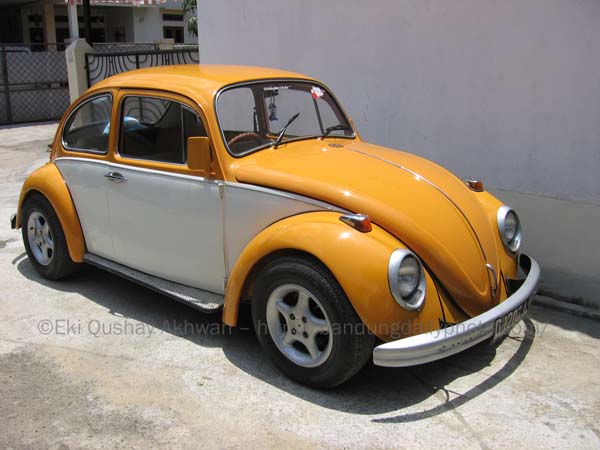
Just by looking at the shape of this headlamp - and before you even look at the embossed VW logo on it's lid - you can definitely tell that this is a photo of VW Beetle. And if you happen to be someone who has a very keen interest in this one of the most influential cars ever built, you'll know that this is of the 1967 model.
1967 is an important year in the development of VW Beetle. It was in this year that the drivetrain or powertrain of the car was significantly improved and the engine capacity enlarged. It was also in this year that the invention of first air conditioning system that was specifically designed for this car was granted a patent. (It was invented by Don P. Dixon of San Antonio, Texas.)
Here are some of the features of the 1967 VW Beetle:
Engine: 1500 cc OHV H4, 40 kilowatts (54 hp) @ 4200 rpm, 105 N·m (77 lb·ft) @ 2600, bore 83 mm, stroke 69 mm, comp ratio 7.5:1
Transmission: 4-speed manual
Wheelbase: 2400 mm (94.5 in)
Length: 4079 mm (160.6 in)
Width: 1539 mm (60.6 in)

As I said in one of my previous posts, VW Beetle is called by different names in different parts of the world. In Indonesia it is called VW Kodok (Toad or Frog VW). To my knowledge, the same name (frog, frogy, toad, toady) is only used in Iran (where it is called folex, which means frog), Iraq (agroga or frog), and partly in Malaysia where it is commonly called kura (turtle) or kodok.