Showing posts with label Culture. Show all posts

Tuesday, November 6, 2012

Mosque Napping

A man was taking a nap after the mid-day prayer at a mosque on Jalan Pajajaran, Bandung.

The mosque is not only a place where people perform their prayers here. For some, it's also a place where they can take a rest or a nap, especially at the mid-day when it's hot outside. Mosques near work places or bus terminals are particularly popular among workers and travelers to rest or take a nap.

There have been some attempts by some mosque administrators to ask or remind people not to use the mosque as a napping or resting place. But they did not seem to heeded. The mosque is an open public space for Muslims and they think it is all right (appropriate?) to use the mosque as a resting place.

Saturday, March 6, 2010

Lampung Sai Bride and Groom


Lampung, a province in the southern tip of the island of Sumatra, has several wedding traditions. One of them is Lampung Sai that I'm featuring here.

Thursday, March 4, 2010

Mad Buffalo


These masked characters are the performers of Seni Helaran Kebo Ngamuk (lit. mad buffalo perfomance art) from the Indramayu regency in the northeastern coast of the Province of West Java (of which Bandung is the capital city).

Kebo Ngamuk performance consists of several acrobatic attractions with a mock-up mad buffalo as the central figure and a number of masked performers like these fighting with the buffalo. The performance is accompanied with dymanic music that is typical of the northern cost of West Java region.

Tuesday, March 2, 2010

My World: Sisingaan

Sisingaan (also called Gotong Singa) or the lion dance is a Sundanese performace art that is originally from the area of Subang in the northern coast of West Java.


This performance consists of several subsets of performances. They include:
(1) Tatalu or arang-arang bubuka, a dynamic musical opening;
(2) Kidung or kembang gadung, a singing performance;
(3) Ibingan, a dancing performance;
(4) a set of accrobatic performances, and
(5) a closing musical performance.


The name "sisingaan" is derived from a pair of lion-like figures that become the central attraction of the show. These lions are usually used to carry children like the ones you see in the pictures.


Sisingaan can be performed at any helaran (festivals). But it is usually performed at circumscision ceremony and other carnivals.

This post is linked to My World Tuesday, a weekly meme where photo bloggers show their worlds through pictures. Please click the link to see posts from paricipating bloggers from around the world.

Friday, October 2, 2009

Batik: An Indonesian Cultural Heritage for The World


I have previously posted this picture before with a different story under Patterns and Colors of Batik Cirebon (Cirebonese Batik). I'm posting it again today to celebrate the official recognition by UNESCO (The United Nations Educational, Scientific, and Cultural Organization) today that batik is an Indonesian cultural heritage. Batik is the third indigenous Indonesian cultural heritage to receive such a recognition after keris and wayang.

Although batik can be found in many parts of the world, nowhere else has the art of batik making been developed to such a high level and practiced with such an enthusiasm like in the Indonesian archipelago. "Documents" and batik patterns inscribed on stone temples dated as far back as the 8th century CE and those written and inscribed on lontar palm leaves dated as far back as the 17th century CE provide undeniable evidence that batik is Indonesian. In addition to this, there are more types, patterns, and genres of batik in Indonesia than anywhere else in the world.

Despite the fact that batik is Indonesian, the path to UNESCO recognition was not an easy one. It began in the year 2000 when Malaysia began to lay claim to batik as its own indigenous cultural heritage. Indonesian batik artisants and producers were furious about this, and after a concerted effort of research, documentation, and seminars, they submitted, on September 4, 2008, the data to counter Malaysia's claim to the UNESCO to be reviewed.

In February 2009, the data were reviewed and verified by an international committee under UNESCO.

On September 28, 2009, UNESCO officially recognized batik as an Indonesian intangible cultural heritage to the world.

Today, October 2, 2009, the recognition was officially delivered to the Indonesian delegates at the closing of the UNESCO's Intergovernmental Committee Convention in Abu Dhabi, UAE.

Tuesday, February 3, 2009

My World: Gatutkaca


Gatutkaca is a "wayang golek" figure. In the epic of Mahabharata - one of the main sources of the narratives for the Javanese and Sundanese wayang performances, Gatotkaca is characterized as a demigod superman whose power includes - among others - the ability to fly. So powerful this character is that it is said that his bones are made of steel and his muscles of wires.

Gatotkaca's power is said to be inherited from his parents: Bimasena or Bima of the Pandawa family, his father, is a fierce but kind-hearted hero, and Hidimbi (better known as Arimbi in Javanese and Sundanese), his mother, is a powerful rakshasa (giant).

The Gatutkaca in the above photo is not the one that is normally used for "wayang golek" performance, but a unique souvenir that you can bring home from Bandung and West Java in general. This souvenir wayang golek is made larger that the one that is normally used for the performance.

This post is Bandung Daily Photo's participation in My World Tuesday Meme. Please follow the link to see other participants' photos and stories.

Tuesday, January 13, 2009

My World: The Indonesian Music of Keroncong


Acculturized from the Portuguese folk music of fado, keroncong began to develop in some parts of the Indonesian archipelago, especially in the Tugu area of what is now Jakarta and Maluku (the Moluccas), in the 19th century. It has since acquired a distinctively Indonesian flavor and hence been considered as an Indonesian musical heritage.

The root of keroncong is said to have been introduced into the Indonesian archipelago by the Portuguese sailors and officers in the 16th century. The earliest form of keroncong is called Moresco, which is characterized by - among others - the dominant use of chordophonic-percussion musical instruments. In its development, various local musical instruments and elements, such as some instruments of the gamelan, seruling bambu (Javanese and Sundanese bamboo flutes), and musical notes, were introduced into the ensemble, thus giving it a distinctively local flavor.

For your information, a keroncong ensemble typically consists of cordophonic musical instruments such as the violin, the guitar, cello, contra bass, three and four strings ukuleles, plus a flute, and some gamelan instruments.

Keroncong became very popular throughout the late 19th and early 20th centuries. Its popularity began to fade only with the introduction of The Beatles' style of music in the 1960s. The music still survives and has its own fans, however, as is shown by this group of young keroncong musicians performing at the Braga Festival last December. I was happy to see that this performance did not only attract audience from the older generations, but also a lot of young people who seemed to enjoy it as much as their parents and grandparents did.

To see what the performance was like and listen to a sample of what this music is like, please enjoy the following 1 minute 52 seconds video clip which I recorded from their performance. (This video can also with viewed at my other blog BANDUNG DAILY PHOTO'S sister site BANDUNG DAILY VIDEO.)


This post is BANDUNG DAILY PHOTO'S participation in MY WORLD Tuesday meme. To see other participants' posts from around the world, please follow the link.

Thursday, December 18, 2008

UPI Students and Faculty Members Plan to Break The Indonesian Record of The Most Numerous Saman Dancers


These students of the Faculty of Language and Art Education of the Indonesia University of Education (UPI), Bandung, were gathering at the university's sports complex today to practice and rehearse for what is planned to be Indonesia's record breaking number of dancers performing Tari Saman (Saman Dance).

The current record was made on June 8 this year at the occasion of the celebration of the 100th anniversary of Indonesia's national awakening at Gelora Bung Karno (Soekarno Sports Complex and Stadium) in Jakarta. 600 people performed the dance then. This time The Faculty of Language and Arts Education of UPI is trying to break that record by involving 700 of its students and faculty members to perform the dance.

Saman Dance is originally from the Indonesian province of Nangroe Aceh Darussalam (Aceh) in the northern tip of Sumatra Island. It is a very dynamic group dance with highly sinchronized choreography.

To see in motion what the rehearsal was like, please check this 30 second YouTube video streaming from Bandung Daily Photo's new sister, Bandung Daily Video.

Sunday, December 14, 2008

Street Photography # 9: Bandung's Youth Culture


Look at the T-shirt this young man is wearing.

Terrorism is horrific, but to fight it and fall into that other thing written on his t-shirt is like escaping the mouth of a tiger and falling into the mouth of a crocodile.

However, I don't think this young man is serious about smoking the homegrown thing (I certainly hope not). Like any young people anywhere, the t-shirt he has chosen to wear may just be a rebellious expression of his young mind.

Rebellious and out of the league expressions are one of the many distinctive features of youth subculture. These expressions can be found in their behaviors, fashions, choices of music genres, vehicles, and even the slangs and language they use.

There are many theories that have been proposed or used by experts to explain about youth subculture. Among them, Stuart Hall's and Tony Jefferson's (1993) and that of the Frankfurt School of Marxist Theory are, I think, most interesting. According to the former, youth subcultures are the symbolic and ritualistic manifestations of attempts to defy the hegemonic power of the bourgeois by a deliberate adoption of symbolic actions that challenge the establishment. The latter theory, meanwhile, suggests that the intrinsically consumerist characteristics of the youth subculture is an inseparable part of the divide-and-rule strategy of capitalism.

I took this photograph at the HELAR Fest held in Bandung last August. The HELAR Fest, as I mentioned in a couple of my previous posts, is an annual event that celebrates Bandung as an emerging creative city. Creativity, as well as the HELAR Fest itself, is the domain of the youths. They are the powerhouse of the future.

Tuesday, November 25, 2008

Jajangkungan: The Tallest Kids in The World (?)


A three meter tall human being would certainly break the record of the tallest person in the world. (The confirmed world record for the tallest person in the world, according to the Guiness Book of Record, is 2.72 meter tall, and is held by Robert Pershing Wadlow [1918-1940] of Alton, Illinois.)

These boys are slightly more than 3 meters tall, but no they are not the tallest persons in the world. They walk on stilts (Indonesian: "egrang") and are part of the "jajangkungan" performing art troupe. They don't just walk on stilts, but also play football (soccer), dance, and even race on them.

"Jajangkungan" by the way is originally a Sundanese (West Javanese people) traditional chidren game.

I took this photo at 2006 Braga Festival. As I said before, Braga Festival is one of the many annual festivals held in Bandung. It's held at the last week of December.

This post is my participation for MY WORLD meme. To see pictures from other participants around the world, please follow the link.

Thursday, October 30, 2008

Bandung Sundanese Traditional Wedding # 2

For the first part of the story please refer to previous post here.

After the welcoming ceremony is completed, the groom and his entourage would be escorted by the dancers to the reception area at the bride's home to meet her family members. Here, speeches are made, prayers said, and the groom's family present the gifts they have brought to the bride's family.


Then the bride and the groom would meet and togehter they would walk to the "altar" (usually a nearby mosque or an especially prepared platform at the reception area) where the bride's father (or somebody he has appointed to represent him) would perform the "ijab" (giving his daughter in marriage) and the groom perform the "kabul" (acceptance of the marriage from the father or legal guardian of the bride.). The couple would then recite their wedding vows as a wife and husband and, as required by the Indonesian law, sign the marriage certificate in front of the appointed official and witnesses.

There are several Sundanese traditional rituals that the married couple usually do after that. Among them are "saweran" (the throwing of coins, rice, and candies) to the audience and well-wishers), the groom's stepping on an egg or bamboo stick and the bride's washing the groom's foot, and, like what is shown in the picture below, "a chicken tug of war" (my translation), where the bride and the groom pull a "bakakak" (a sliced-open grilled chicken). It is believed that if the groom gets a larger piece of the chicken, they would be blessed with a son soon, and vice versa, if the bride gets the larger piece, then they would be blessed with a daughter.


The couple would then feed each other in a symbolic act that in a marriage a wife and a husband have the shared resposibility of supporting each other.


Tuesday, October 28, 2008

My World Tuesday Post: The Dance of The Peacock


I know, I promised you that I'd post the second installment of the photo essay about Bandung's traditional wedding; but the essay involves a lot of photos and quite a bit of a story to tell, and frankly speaking I'm a bit busy today and don't have the time to prepare and upload the photos and write the story. So, instead of continuing with the essay, today I bring you this photo of these beautiful "Tari Merak" dancers.

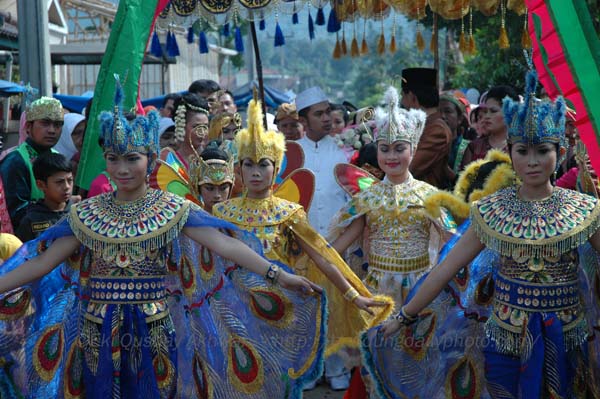
These "Tari Merak" (Dance of The Peacock) dancers are part of the party that welcome the groom's entourage at my friend's wedding last Sunday (see yesterday's post).

"Tari Merak" is a relatively new composition dance. It was coreographed by a prominent Bandung (Sundanese) artist Raden Tjetje Somantri in the 1950s. The graceful movements of this dance are inspired by the behavior of "burung merak" (the peacock), a native Indonesian bird that is known worldwide for its beautiful and colorful feathers.

The coreography of "Tari Merak" has been revised/modified twice since it was created. Both modifications were made by Irawati Durban Ardjo. The first modification was made in 1965, and the second in 1985.

This post is my participation for the new meme My World Tuesday. To see photos and stories from other participating blogs from around the world, please follow this link.

Monday, October 27, 2008

Photo Essay: A Bandung Sundanese Traditional Wedding #1

Photos and Text by Eki Qushay Akhwan

In any cultures, a wedding is always a sacred and happy occasion. The sacredness and happiness of this occasion may find different expressions in different cultures. But essential things are almost always there: A family meeting, a blessing, a vow, and a party or feast.

A traditional Bandung (Sundanese) wedding begins long before the D day when the groom's family visits the bride's family to do what Sundanese call "nendeun omong" (giving words). This is not a formal proposal, but an introduction between the two families in which the groom's family informally states (give words of) their intention of proposing the other family's daughter for their son. This is then followed by a formal proposal or what the Sundanese call "narosan" (asking). Here the groom's family formally ask the girl if she would be willing to marry their son. If the girl agrees, then both families will set the date and begin preparations for the D day.

Here is what typically happens on the D day:
The groom leaves home with an entourage of family members and gifts ("seserahan")for the bride and her family. The gift typically includes all the bride's daily needs (several sets of clothes, shoes, make up, and even jewelery and a house if the groom can afford it), and foods (rice, fruit, vegetables, chicken, goat, etc.) and money. The later items are meant to help share the cost of the girl's family expenses in giving the reception party.
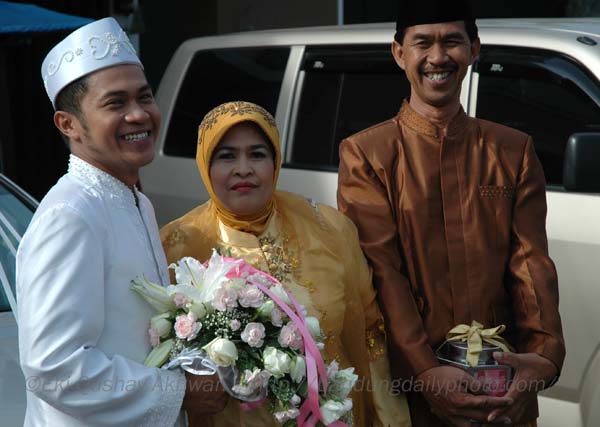


Photo 1: The groom and his family is ready to leave home for the bride's. The jar held by the groom's uncle is gift money for the bride's family.
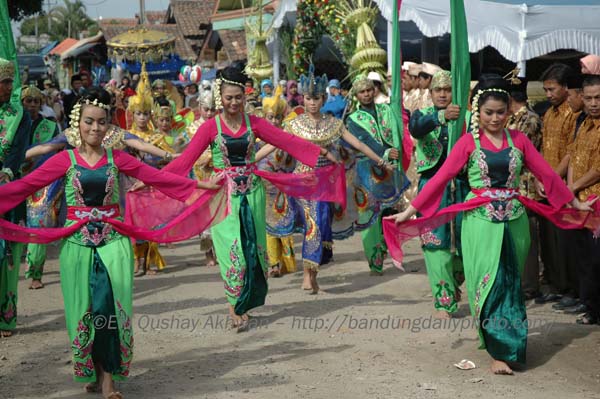


Photo 2: When the groom's entourage arrives on the road that leads to the bride's home, several groups of dancers welcome them.
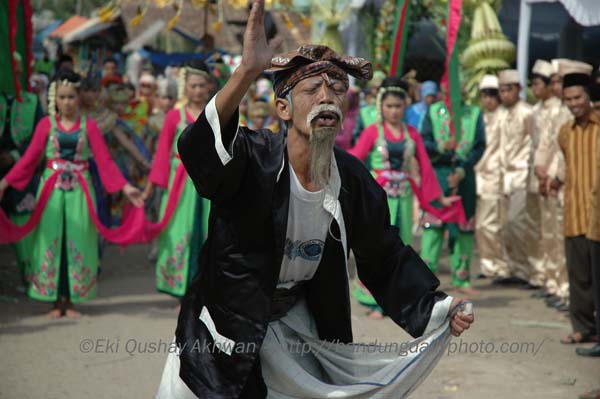


Photo 3: The welcoming party includes two old or senior figures (each representing the bride's and the groom's families) that symblolize the ancestors' wisdom. Through the dialoges they perform, they impart wisdoms and advice about the journey of family life that they couple is about to embark on.
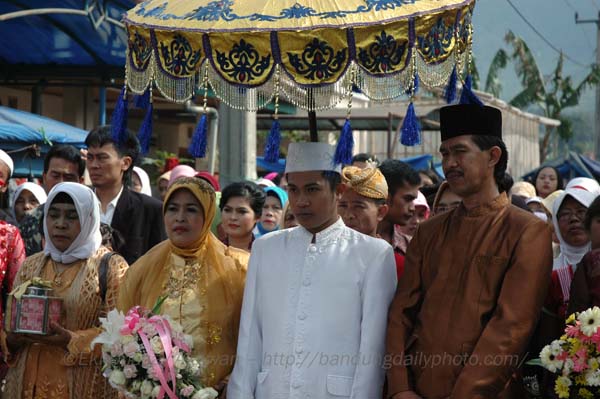


Photo 4: While all this is happening, the groom and his entourage are waiting and listening until they are invited to proceed to the bride's home.

To be continued in part 2 tomorrow.

Sunday, October 26, 2008

Wayang Golek


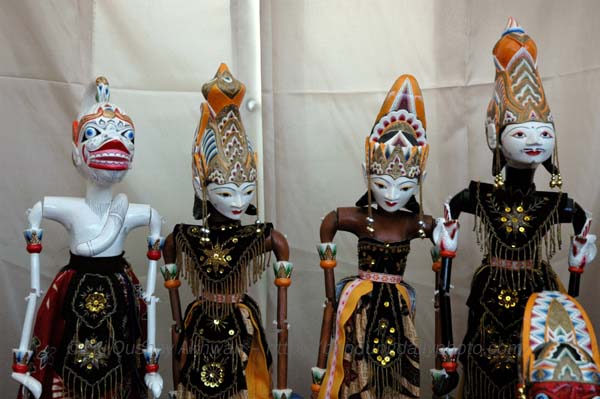
The term “Wayang golek” refers both to the or the traditional Sundanese (West Javanese) wooden puppets and the show with this kind of puppets. Unlike any other wayang puppets in other parts of Indonesia which are made of goat skin and are performed as a behind-the-screen shadow show, “wayang golek” is made of wood and is performed without the screen.

The word “wayang” may have come from the words “Wa” and “Hyang” (which together mean ancestors) or “bayang” (shadow).

“Wayang golek” show is performed by a puppeteer called “dalang” with an ensemble of “gamelan” music. The show is usually performed in the evening and typically lasts for about six hours. Originally, “wayang golek” used to be performed only at thanksgiving, harvest parties, and ceremonies to ask for God’s protection from evil spirits. Now it is also performed at wedding receptions, circumscision ceremony, company’s unniversaries, and other social functions.

The stories at “wayang golek” performance are typically dirived from the Hindu-Indian epics of Ramayana and Mahabarata. However, they have been adapted to the local Sundanese Moslem wisdom and values.

The photo above are four of “wayang golek” characters. I took this photo at the Kemilau Nusantara fest (see yesterday’s post).