Showing posts with label Destinations and Attractions. Show all posts

Tuesday, December 10, 2013

View From The Observation Deck of Mt. Tangkuban Perahu


Here is the northeastward view from one of the two observation decks at Mt. Tangkuban Perahu. The Kawah Ratu (Queen Crater) in the previous post is on your left side. On a clear day like this the view is marvellous.

Tuesday, March 3, 2009

My World: Saung Angklung Udjo (SAU)


The above photo is of Angklung Jaipong dance, one of the art and cultural performances staged at Saung Angklung Udjo (Udjo's Angklung House).

Among many performing art groups and houses in Bandung, Saung Angklung Ujdo (or SAU for short) is probably unique in that it is professionally managed and stages performances of a wide array of Sundanese (West Javanese) arts on the daily basis. Established in 1966 by the late Udjo Ngalagena or Mang Udjo and his wife Uum Sumiati, SAU takes pride in its vision and mission not only as a place where Sundanese arts are performed, but also as a living art laboratory and an institution that strive to preserve the Sundanese cultural heritage and provide community-based art education.


The word "angklung" that makes up its name indicates SAU's specialty in this kind of bamboo musical intrument. Angklung is a Sundanese (West Javanese) traditional musical instrument made of bamboo. Angklung performances are the main stapple of SAU's menu. Throughout the two hour daily performances, the angklung and Sundanese bamboo music makes up five out of ten performances given. In one of them, the audience is given a chance to play angklung together as an orchestra with the guidance of an expert teacher. Please check my other blog BANDUNG DAILY VIDEO at some later time to hear the music and see how angklung is played.

Other performances offered at SAU include a Wayang Golek demonstration, Tari Topeng Cirebon (Cirebonese Mask Dance), and Helaran (festive celebration of important occasions in the Sundanese society), and Tari Merak (Peacock Dance).

SAU is located on Jalan Padasuka 118 in the east of Bandung.


This post is BANDUNG DAILY PHOTO's participation in My World Tuesday. Please click the link to check other posts from the participating blogs from around the world.

Monday, February 9, 2009

Camel Ride


Camel ride at Bandung Zoo.

Bandung Zoo has quite a number of one-humped or Arabian camels (camelus dromedarius). Some of them are made available for a ride, like this one.

Friday, January 30, 2009

Skywatch: The Sundial Observation Deck


This is the bottom view of the observation deck and tip of the hand (called gnomon) of the Sundial at Kota Baru Parahyangan in the West of Bandung. For those of you who did not regularly follow my blog, I have previously posted a photo and story about this sundial here.

For a more comprehensive information about sundials, you may want to read this wikipedia article.

This post is BANDUNG DAILY PHOTO's participation in the weekly Skywatch Friday meme. Please check out the link to see other participants' photos.

Monday, January 26, 2009

Chinese New Year in Bandung: The Barongsai Performance


As of mid-night last night, Chinese all over the world welcome the new lunar year of 2560. Happy New Year to those who celebrate it.

Although Chinese only makes up a small percentage (roughly about 5 - 7 percent) of the Indonesian population, the Chinese New Year, called Imlek or Sin Tjia in Indonesian, is a national holiday and a festive celebration here. The celebrations involve not only the ethnic Chinese but also Indonesians of other ethnicity.

The Chinese would normally go to the temple to pray on the New Year's Eve. It is also customary for them to give "Ang Pao" (envelopes containing gift money) to the poor and their relatives after the prayer, have a family gathering, feast, and fire works. In addition to these, different cultural performances are also staged. One such performances - and the most popular here - is the Barongsai (the Dragon-Lion Dance) shown in these photos.

I took these photos at Ciwalk (Cihampelas Walk) today. In the top photo, a child is giving an Ang Pao to one of the Barongsais. The bottom photo shows the crowds enjoying and cheering at the various acrobatic tricks that these Barongsais were performing.

Sunday, January 25, 2009

Bandung Zoo: The Elephant Safari Ride


Covering an area of only about 14 hectares, Kebun Binatang Bandung (Bandung Zoological Park or Bandung Zoo) is not very big, but it is very historical and popular. The zoo was officially established in 1933 when two previously existing zoos (Cimindi in the western part of the city and Dago Atas in the northern part of the city) were merged and their animal collections were moved to the current location at Taman Sari street near the campus of Bandung Institute of Technology.

Prior to the establishment of the zoo, Taman Sari was a botanical garden. This garden, named "Jubileum Park", was established in 1923 to commemorate the Silver Jubilee of Queen Wilhelmina of the Netherlands, the then colonial ruler of the Indonesian archipelago.

Bandung zoo currently has a collection of 218 species with nearly 1600 individual animals. In addition to the animals, the zoo also offers a variety of other attractions, such as this elephant safari ride. I'm going to post some more pictures and stories about this zoo later.

Saturday, October 25, 2008

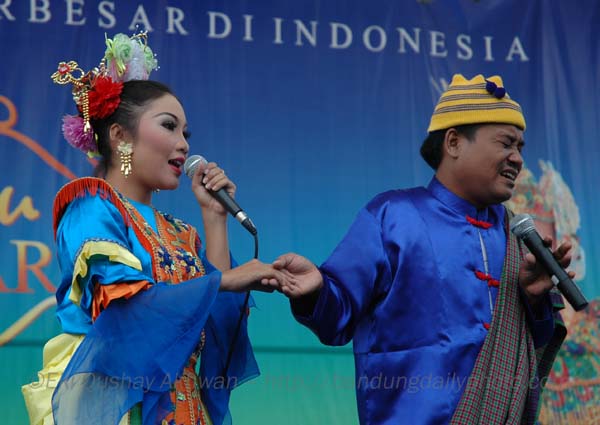
Bandung's "Kemilau Nusantara" Fest: A Lenong Dancer and A Joker


"Kemilau Nusantara" or the Glitter of the Indonesian Archipelago is an annual event held by Bandung's Tourism Office. This festival features tourism, art, and cultural exhibitions from all the regencies in the Province of West Java and other provinces in Indonesia plus a grand street parade of art and cultural performances from all the participating regions. This year event, the fifth, began yesterday and will last until tomorrow when the parade is going to take place.

I went to Lapangan Gasibu (the Gasibu Square), the venue of this event, today and enjoyed the various stage cultural performances from different parts of Indonesia. Unfortunately, I won't be able to be there tomorrow to cover the parade since, as I said earlier in the week, I would be doing wedding photography for my friend's wedding. I hope the other Bandung Daily Photo blogs (Harry's and Benyamin's) will be covering the event for you.

The photo featured above is of a Lenong dancer and joker. Lenong is a traditional Betawi (Jakarta's indigenous people) folk theater. The joker together with the dancers hold a very important role in this folk theater: The Joker is a central character that makes the moral message of the story more digestable to the audience. The dancers (and their dances) provide a lively and colorful intermezzo so that the audience can stay "awake" and follow the often long performance.

Monday, October 20, 2008

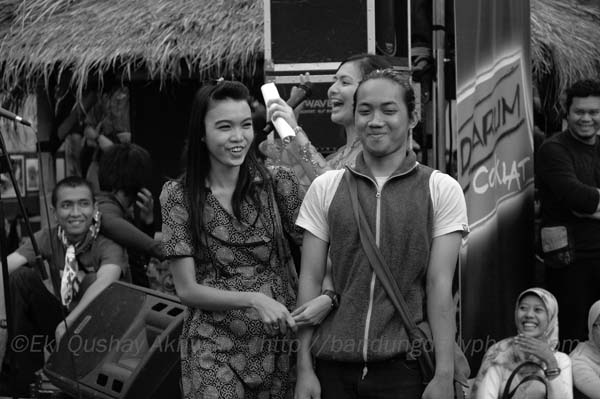
City of People # 16: Wedding Impersonators (Happy People Make A Happy City)


I took this photo of a wedding impersonator couple at a street festival on Jalan Braga, Bandung, sometime ago.

The story behind the photo:
At this festival, the stage managers (masters of ceremony) asked the audience if any of them would like to impersonate a bride and a groom walking the isle in a wedding reception for a prize. Many of the audience seemed to be reluctant to volunteer. So they had to randomly pick this couple from the audience. The girl seemed to be happy, the boy a bit shy. This scene made the audience amused, cheer, and laugh.

Speaking of wedding: I am co-photographing a friend's wedding next week (real wedding!). I have asked my friend and his wife to be if I could post some of the photos I will be taking on this blog. They have agreed. So, next week I am going to share with you a story and some photos of a traditional Sundanese wedding.

By the way, I am not a professional (i.e. money making) wedding photographer, but yes I've done quite a few professional wedding photography "jobs". I'd usually do them for friends or relatives and for free.

Sunday, October 19, 2008

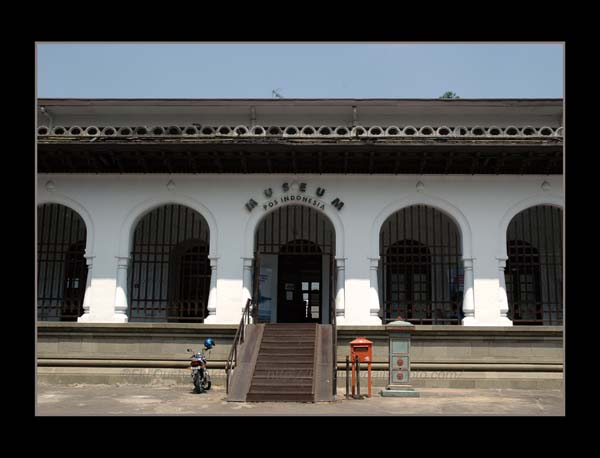
Bandung's Museums: Museum Pos Indonesia


Museum Pos Indonesia or the Indonesian Postal Museum is located east of Gedung Sate (West Java Gubernatorial Office Mansion) on Jalan Cilaki 73 (73 Cilaki Street), Bandung. Its building was in fact built as part of the Gedung Sate office complex. That is why they share the same architectural features.

Museum Pos Indonesia was established in 1933 as Post, Telegraph, and Telephone Museum (Museum PTT). It has the most extensive collection of stamps and other philatelic objects from all over the world, which include the oldest stamp in Indonesia (then the Netherlands’ East India) and some of the oldest stamps in the world. It also collects some of the world’s oldest post, telegraph, and telephone equipments and an impressive number of documents (photograph, pictures, paintings, leaflets, etc) that record the history of the development of the post, telegraph, and telephone services in Indonesia.

This museum is open for public free from 9 AM to 4 PM Monday through Friday, and from 9 AM to 2 PM on Saturday.

Friday, October 10, 2008

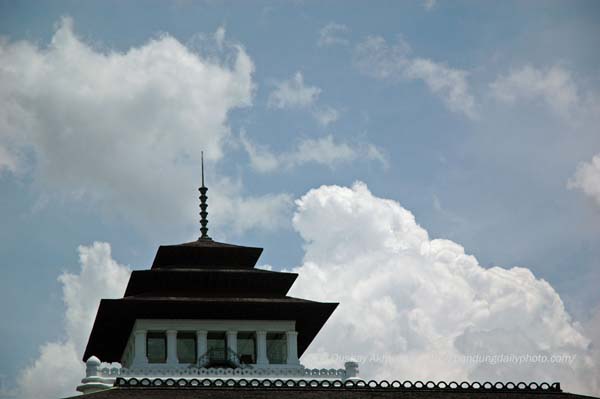
Skywatch Friday Post: Gedung Sate's Tiered Roof

GEDUNG SATE TIERED ROOF copyrights Eki Akhwan

This is the top floor terrace and the tiered roof of Gedung Sate. The skewered-barbecue (Indonesian: Sate) like structure at the top is what makes the building named "Gedung Sate" (Sate Building). For those of you who did not follow this blog regularly, you might want to refer here for the some architectural notes about this building.

Today's post is for my participation in the Skywatch Friday. To see other participants' photos, please check here

Wednesday, October 8, 2008

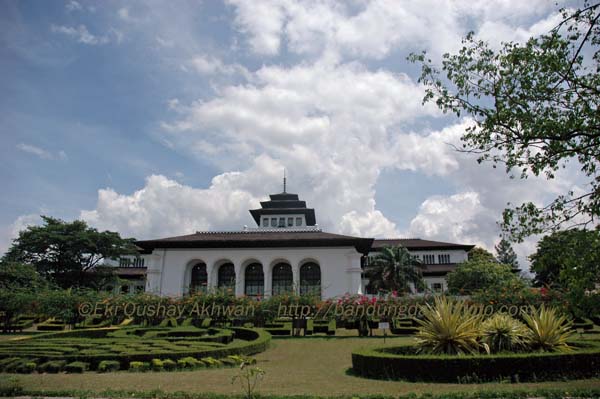
Gedung Sate #2: Southern Facade and Some Architectural Notes

SOUTHERN FACADE OF GEDUNG SATE copyrights Eki Akhwan

This is the photo of the southern facade of Gedung Sate and its surrounding tropical gardens.

Some architectural notes of Gedung Sate:
Gedung Sate was designed by architect J. Gerber. The construction began on July 27, 1920, and was completed in four years. According to Bandung historian Haryoto Kunto, thousands of workers were involved in its construction, including a number of craftsmen and artisans who were especially invited from China to do the detailed ornaments of the building.

Gedung Sate's architecture is unique in that it combines Western architectural design and elements adopted from local and regional architecture. The tiered roof at the center, for example, is said to be adopted from the Balinese temple "meru" structure. The ornaments of the main gate at the front is quite probably adopted from Thai temple architecture. While the doors, huge windows, and some wall ornamental features bear resemblance to Indian and Spanish architectural elements.

Gedung Sate has five levels (floors). The first three floors house the different departments of the Provincial Government of West Java. The fourth floor functions as an exhibition hall and a theater where historical photographs of Bandung and West Java are exhibited and a 30 minute documentary film of the same are screened for visitors. The fifth floor, which is located right under the tiered roof, can only be accessed through a speacial staircase. It functions as a terrace where the governor of West Java entertains guests of honors for tea or coffee. From this terrace tower, one can see the majestic Mount Tangkuban Parahu (which literally means: capsized boat) in the north and other mountains surounding Bandung plateau.

Saturday, September 13, 2008

The Southern Facade of Villa Isola

Villa Isola 2 copyrights Eki Akhwan


Text and picture by Eki Qushay Akhwan
I received quite a number of great comments for my yesterday's Skywatch Friday post about Villa Isola or Bumi Siliwangi. Thank you all.

My good friend Virginia of Birmingham, Alabama, Daily Photo asked me if I could post a closer look photo of the building. Her (and your) wish is my command. So, here it is another photo of Villa Isola or Bumi Siliwangi. This is the southern facade of the building, the one overlooking the valley with the view of the city of Bandung underneath. (Yesterday's photo was that of the northern facade overlooking Mt Tangkuban Parahu.)

A little bit more information about the building:
Villa Isola and its surrounding gardens occupied an area of 120,000 square meters, cost about a half million of the 1930's Dutch guilders to build (I don't how much that would be in today's money value, but it must be a lot). The name Villa Isola itself comes from a placard that Barretty had ordered to be made and placed that read "Me Isolo e Vivo" (in Italian) which means "I isolate my self and live." Back then, Villa Isola was of course a remote countryside area.

Friday, September 12, 2008

The Historic Villa Isola - A Skywatch Post

VILA ISOLA copyrights Eki Akhwan

Text and picture by Eki Qushay Akhwan


Villa Isola (now called Bumi Siliwangi) is the rectorate office of Bandung's Indonesia University of Education (UPI). Located on Jalan Dr. Setiabudhi 229 overlooking the valley with the view of the city underneath, it is arguably one of the most beautiful historical buildings in Bandung and one of the most celebrated examples of art deco architectural heritage in the Asia Pacific region.

Villa Isola was built in 1932-1933 by a reknown Dutch East India's architect Wolff Schoemaker for the Dutch media tycoon Dominique William Berretty. Unfortunately, he did not live long enough to enjoy his treasured home villa. He died in 1934 in a plane crash enroute from Batavia (now, Jakarta) to Amsterdam six months after he moved into the villa.

Upon his death, the villa was sold and turned into a hotel. When the Japanese invaded what was then the Dutch East India in 1942, the building once again changed hands and became the headquarters for the Japanese Imperial Army in Bandung. The Indonesian people's liberation army took it over from the Japanese in 1945 when Indonesia declared it's independence and made it their headquarters. In 1954, the building was restored to its original condition and made into the main offices of what was then Perguruan Tinggi Pendidikan Guru (PTPG), Indonesia's first teachers' college, and what is now the Indonesia University of Education (UPI).

About the Photo:
I took this photo from the parking lot of my newly constructed office building, which is located just across a narrow on-campus road from this building a couple of days ago. It had been cloudy that day, but I was lucky. By the time I finished my classes and was ready to go home that afternoon, the sky cleared a bit and provided an excellent lighting condition for this beautiful skywatch shot.

Welcome to and enjoy my second Skywatch Friday post! And thank you for your visit and comment.

Tuesday, September 9, 2008

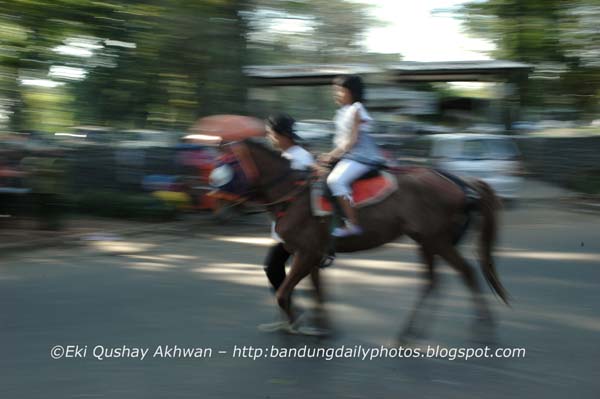
Ride Your Horse or Run with It ...

5 JULI 2008 NIKON D70 034

Text and picture by Eki Qushay Akhwan

The title of this post might have you baffled. But yes, it's what happens here. Well, sort of. :)

Horse riding is one of the attractions offered at Ganesha Street and the areas around Bandung Zoo. The service is offered particulary to children (adults are welcome too) for 15 to 50 thousand rupiahs (about 2 up to 5 US dollars) depending on how long the round you or your children want to have. Children love this. For safety reason though, they can't ride on their own. The owner of the horse would run alongside the horse, guiding it and its running pace, while a child is riding it. On a good weekend day, a horse owner like in the above photo could have 5 up to 10 rides on his horse. Imagine how much running he has to do if each round is about two kilometers long. It must be quite an exercise for him, but hey ... he's making reasonably good money too.

__________

The above photo is an example of a rather unsuccessful attempt at camera panning, i.e. a technique in photography in which a photographer, setting his/her camera on slow shutter speed, turns it horizontally to follow a subjec't motion and create the illusion of motion - still subject with steaked background - in a picture.

Saturday, September 6, 2008

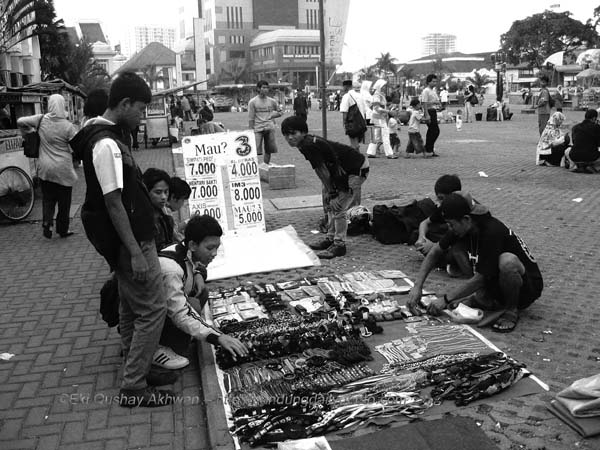
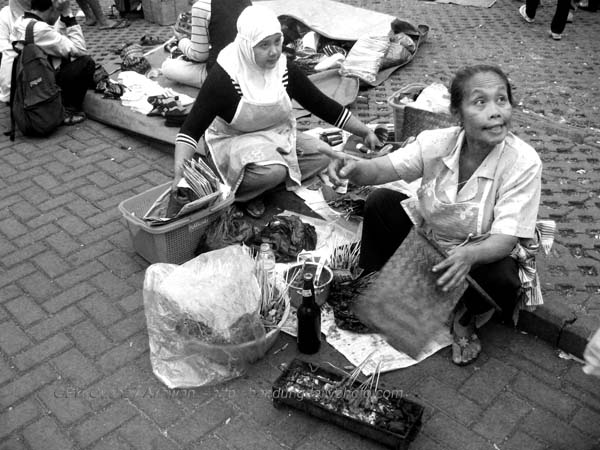
"Alun-alun" Bandung - Life at Bandung's City Square #1

TUKANG TAHU GEJROT
"Tahu Gejrot" vendor at Bandung City Square - ©Eki Qushay Akhwan

Text and pictures copyrights ©Eki Qushay Akhwan, all rights reserved

City square (or in Indonesian "alun-alun") holds a very important function in the Javanese cosmological concept of a city. Alun-alun is not just an open public space or park in the center of the city. It is literally the front yard of a king/ruler's palace/residence. Surrounding it are the various symbols of a society/nation's livelihood. By rule, the palace should be located on the southern part of the square, facing north. On the west is placed a house of worship (the divine element: a mosque in Moslem Indonesia; a temple in Hindu era Indonesia). East of the square is the place for the market (the mundane/worldly element), and north is the place for the administrative offices of the kingdom/country/city.

Bandung's city square is as old as the city itself. The square was built as part of the new capital city of Bandung Regency in the early 19th century (before then, the capital was located at Dayeuh Kolot [old city], further south of where the current city square is located). The square's face has undergone a lot of changes since then, but one thing remains the same: It's still a bustling, open public space where citizens meet and do different kinds of activities.

In this series of photo coverage, I am trying to show you what life is like at Bandung's City Square today.

PENJUAL SABUK ALUN ALUN
Leatherware and trinkets vendor at Bandung City Square - ©Eki Qushay Akhwan


TUKANG SATE ALUN-ALUN copyrights Eki Q Akhwan
"Sate" vendor at Bandung City Square - ©Eki Qushay Akhwan

Wednesday, August 20, 2008

Bandung Countryside #2 and The Strawberry Story

morning in bandung 1

Text and pictures by Eki Qushay Akhwan

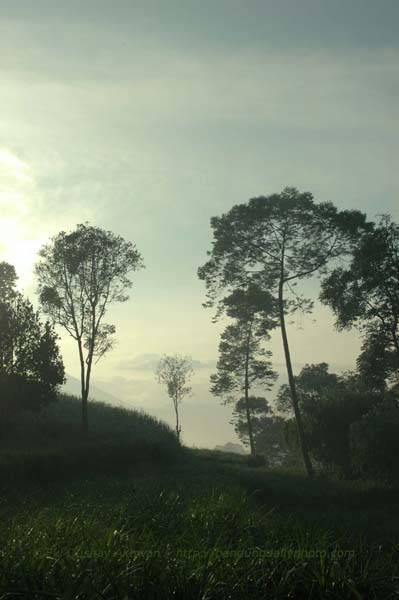
This is another photo I took at my morning countryside walk with some colleagues recently.

As I said before, Bandung may be a bustling metropolis, but the countrysides surrounding it are still very rural and scenic; better still, they are never far away. This scenic panorama of a village in Cikole area, for example, is located only 17 kilometers (about 10 miles) north of Bandung.

Being located on a highland and surrounded by mountains and volcanoes, Bandung's soil is very fertile. Combine that with the mild and cool climate, what you get is abundance of agriculture produce (I said here, Bandung and West Java in general have the largest and most productive tea plantations in the country). Bandung is a major producer and one of the largest suppliers of vegetables on the island of Java.

Bandung Strawberry


Strawberry, or more precisely garden strawberry (Fragaria X Ananassa), the most common variety of strawberry cultivated worldwide, is the offspring of the accidental cross between North American strawberry (Fragaria Virginiana) whose nice flavor is very well known, and bigger-sized Chilean stawberry (Fragaria Chiloensis). This plant was first cultivated in Europe in the 18th century. There is a large varieties of stawberry cultivated worldwide, but this garden stawberry is supposed to be their Adam and Eve ^_^, including those cultivated in Bandung.

"Strawberry Tourism" (my term) is now very popular in Bandung. A lot of stawberry gardens are now open for the sole purpose of entertaining visitors's curiosity about this non-native plant. In these places you can pick this savory fruit yourselves, then weigh your picks and pay them at the cashier. Prices range from about 20,000 rupiahs (about US$2.2) to 30,000 (about US$ 3.3) per kilogram, depending on size and ripeness.

Saturday, August 9, 2008

Walini Tea Plantation

Ciwalini Tea Plantation

Text and picture by Eki Qushay Akhwan

Located on a high land and surrounded by mountains, Bandung and its surrounding areas have long been known for their ideal climate and fertility for agroindustry. This potential was well exploited by the Dutch to plant commodity crops such as tea, coffee, and quinine.

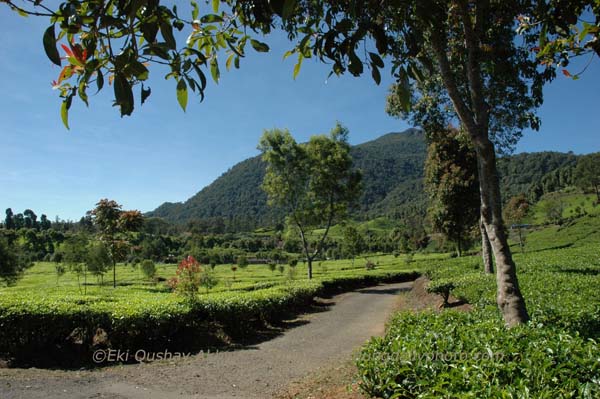
Huge tea, coffee, and quinine plantations can be found in the north and south of Bandung. Pictured above is Walini tea plantation located near Kawah Putih (White Crater). This plantation is now owned and managed by a state-owned company PT Perkebunan VIII (Persero). In addition to being a productive plantation producing high quality high land tea, this plantation is now also being offered as an agrotourism destination where visitors can have tea walk, horse ride, and other activities. Right in the middle of this plantation, there is also a natural hot water pool where visitors can swim or have a relaxing hot bath in private bathrooms.

Photography tip of the day: Landscape photography #2
Another thing that we can do to improve the impact of our landscape photographs is to place an object of interest in the foreground to create a sense of depth. In the picture above, the tree I placed in the foreground and the path helped create a sense of depth in the landscape.

Friday, August 8, 2008

Negeri di Atas Awan - A Land over the Clouds

080808A

080808B

Text and pictures by Eki Qushay Akhwan

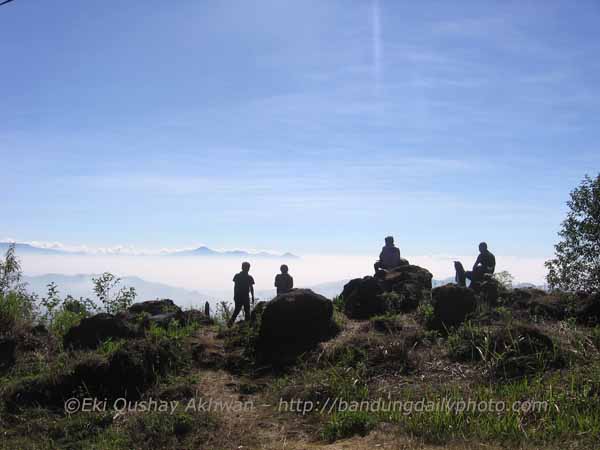
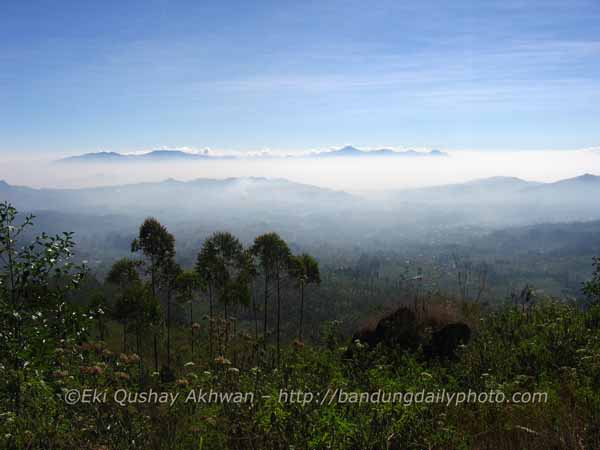
On the way up to Kawah Putih (White Crater), there is a forest clearing right on the side of road where we can see the whole mountain range in the South of Bandung. The view from this high vantage point is so breathtaking, that it's worth stopping by just to sit and enjoy the view. To me, it's also a great place to reflect upon the greatness of nature and of our place in it.

Photography tip of the day: Landscape Photography
I took these pictures with a small point and shoot camera, my faithful Canon Powershot A510. I didn't have much control over the exposure. But even with a point and shoot pocket camera, great landscape photographs can still be made. With landscape photography, one of the things we can do to improve the impact of our photographs is to find a high vantage point which could give you a commanding point of the scene. If you have an SLR camera, which gives you control over the exposure, set the aperture to the smallest (larger f number, e.g. f/11, f/16, f/22) to give a wider/deeper Depth of Field, so that every detail will be sharp and in focus.

Thursday, August 7, 2008

KAWAH PUTIH (The White Crater): The Legend

KAWAH PUTIH 2


Text and picture by Eki Qushay Akhwan

Before being discovered in 1837, the people who lived around Mt. Patuha believed that the mountain top was a sacred place, haunted by the holy spirits of their the their ancestors. They would never venture anywhere near the mountain top's forests. A trespass like that would mean bad luck or even death. They also believed that on certain nights these spirits would have a meeting discussing the security and welfare of their people and the conservation of the forests and the natural recources that supported their livelihood.

The legend had had the beauty of Kawah Putih hidden and the pristine forests surrounding it preseved for centuries until its discovery in 1837.

A note about the color of the water:
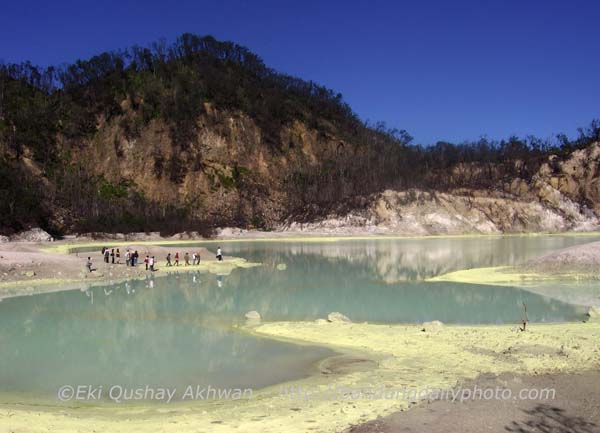
Kawah Putih is a crater lake that covers an active (fumarolic) volcano which has been dormant since 1600. As such they water is typically acidic, saturated with volcanic gases, and cloudy with a strong greenish color. (Wikipedia: Crater Lake).

kawah putih 3


Wednesday, August 6, 2008

KAWAH PUTIH - The White Crater

3 Agustus 2008 CANON A 510 101B


Text and picture by Eki Qushay Akhwan

A Singaporean photographer friend, his wife, and their Malaysian friends came to visit this weekend. I took them to Kawah Putih (which literally means White Crater) in the south of Bandung on Sunday.

Kawah Putih is arguably one of the most beautiful crater lakes on the island of Java, and quite probably in the Indonesian archipelago. It is located about 46 kilometers south of Bandung on Patuha mountain (2,434 meters above sea level). The crater was discovered by a Dutch-German botanist and platation estate owner Franz Wilhelm Junghuhn in 1837. According to geologists, this crater lake was created as a result of Mt. Patuha volcanic erruption in the year 1000 - 1200.

More photos and stories about it on tomorrow's post.