Showing posts with label Natural Views and Phenomena. Show all posts

Monday, August 1, 2011

August 2011 Theme Day: Kawah Putih Revisited


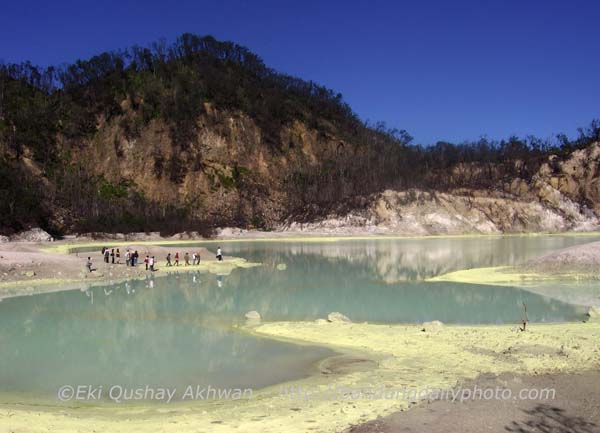
Back in August 2008, I posted two stories about Kawah Putih (White Crater): here and here. The pictures shown in those posts were taken during the peak of the dry season and the crater lake looked shallow. I visited the crater again early this year during the wet season when the water was higher and took some more photos. This is one of them. I am sharing it with you today to show you a different view of the lake.

This photo and post is Bandung Daily Photo's participation in this month's CDPB Theme Day: Postcard-worthy. Click here to view thumbnails for all participants

Sunday, September 27, 2009

The Cimanuk River


Having its spring in the Papandayan Mountain in Garut and crossing four regencies (Garut, Sumedang, Majalengka, and Indramayu), Sungai Cimanuk (The Cimanuk River) is one of the longest rivers in West Java. I took this scenic section of the river at Wado area in the border of Sumedang and Majalengka about 100 kilometers east of Bandung.

This post is Bandung Daily Photo's participation in Scenic Sunday meme. To see other participating blogs, please click the logo picture underneath.

Scenic Sunday

Friday, January 16, 2009

Skywatch Friday: The Colors of The Sky


Bandung's sky has been cloudy most of the time this week. It's been raining almost everyday. So, the photo for my participation in this week's Skywatch Friday meme is not exactly a photo I took this week. It is another photo that I took at the same time as the one I posted on 2 January 2009. Again, this is a straight shot or an as-is image as recorded by the camera.

Many of us already know why the sky change colors at different parts of the day (yellow, orange, amber, or red at sunrise and sunset and blue at a clear day time). For those who forget, here is a reminder:

The change in sky's colors as we perceive it (blue in a clear day time and amber or red at sunrise and sunset) takes place because of a phenomenon that physicists call "scattering", a process by which the light coming from the sun is scattered by the earth's electromagnetically-charged atmospheric particles.

Here is how it happens. The light that comes from the sun actually consists of a spectrum of lights of different wavelengths. On a clear day, blue and violet rays that have shorter wavelengths are dispersed more than the other colors in the light spectrum. Hence, we see blue sky. (The violet is barely visible because the retina of our eyes cannot perceive it as well as they do blue.) At sunrise and sunset, because the sun is low on the horizon, the sunlight has to travel a longer distance to reach our eyes and pass through more "layers" of atmospheric particles. Because of this, the blue and violet rays are exhaustively scattered to the point where they become nearly invisible to our eyes. That is why we only see longer wavelength spectrum light elements of red, orange, amber, and yellow, which are less dispersed.

The explanation for the change of sky colors at different parts of the day was first found by John Tyndall in 1859. That is why this explanation is called the Tyndall Effect.

Friday, January 9, 2009

Skywatch Friday: Evening Clouds Over Mt. Burangrang


Mt. Burangrang (local words: Gunung Burangrang) is one of the mountains that surround Bandung. It is located to the northwest side of the city and is about 2,057 meters (about 6740 feet) high.

Mt. Burangrang is quite popular among local mountain climbers and hikers. Its pristine forests and challenging contours and proximity to the city makes it an ideal place for weekend mountain climbers. A number of local mountaineering clubs and SAR (search and rescue) team often use it as their training ground. The Indonesian Marine Corp also has its exclusive (no public aceess) training ground on one of its valleys.

I took this photo a few weeks ago from one of the back roads that connects the northern part of Bandung and its western suburban town of Cimahi. This is a straight shot. Except for the watermarking and resizing, I did not do any post-capture editing on this photo.

Today's post is BANDUNG DAILY PHOTO'S participation in the weekly Skywatch Friday meme. To see other photos of the participating blogs of the meme, please follow the link.

Friday, January 2, 2009

Skywatch: Bandung Sunset January 02, 2008 - How to Take Golden Sunset Photograph with Your Digital Pocket Camera


This is what Bandung sunset looked like today.

This is a fresh (as is) photo from my 3.2 mega pixel digital pocket camera. I did no post-capture enhancement whatsoever to the photograph. I took this photo from the parking lot of Borma Supermarket on Jalan Dr. Setiabudhi in the north of Bandung at about six o'clock today.

Perhaps you're wondering how an old, cheap digital camera could take a picture as good as this?

Well, here is the simple tip for taking a golden sunset photo:
To take a golden sunset like this, set your camera white balance to "sunny" (usually symbolized with the sun icon in your camera button). This way, the warmth glow of the sunset sky will be rendered most strongly on the camera sensor. Try it. You'll be pleased at how your golden sunset photograph turns out.

This post is Bandung Daily Photo's participation in the weekly Skywatch Friday meme. To see other wonderful photographs of the sky this week, please follow the link.

Sunday, November 30, 2008

Rose Sky Over The Pentagon


This dilapidated building, now fenced off and slotted for demolition, is called The Pentagon because of its shape: It has five sides and five angles. It used to be the home of The Faculty of Language and Art Education of the Indonesia University of Education (Fakultas Pendidikan Bahasa dan Seni, Universitas Pendidikan Indonesia), Bandung. I used to study here, so I have a lot of memories about this building.

This photo is part of the series of photos I took last Friday (see my Skywatch Friday Post of 28 November). I took about 80 shots in about an hour before the sunset, following the change of colors of the sky of that magnificent late afternoon. This is an unedited, un-retouched photo. The colors and everything in it are as taken and recorded by my faithful 3.2 megapixel pocket digital camera.

Wednesday, November 26, 2008

Bandung Countryside # 3: Jakarta - Bandung Train Window View


I took this photo from behind the glass window of Bandung - Jakarta train.

It is believed that when God smiled, "Parahiyangan" (the Sundanse land of West Java) was created.

Friday, September 26, 2008

Skywatch Post: Bandung's Late Afternoon Sky

Evening on Campus - Copyrights Eki Akhwan


Here comes that day of week again, Friday, the Skywatch Day.

My SWF photo today is of Bandung's late afternoon sky. I shot this photograph last Friday from the parking lot of the Indonesia University of Education (UPI) campus in the north of Bandung. The near shillouette building behind the trees at the background is the new student house (dormitory) whose construction has only recently been completed.

You can go here to check other photos of this week's Skywatch Friday posts.

Sunday, September 7, 2008

The Home Story of Adenium, Jambu Batu, and Kedongdong

H0ME 2

Text and pictures by Eki Qushay Akhwan

Thank God, it's weekend! Time for quieter moments at home. Time to be with family and loved ones. Time to take care of my plants and garden, which I have been neglecting for sometime.

I know, today's photos would not be qualified to be a City Daily Photo post, but I can't help it. I need to take a break from journaling Bandung, just for today.

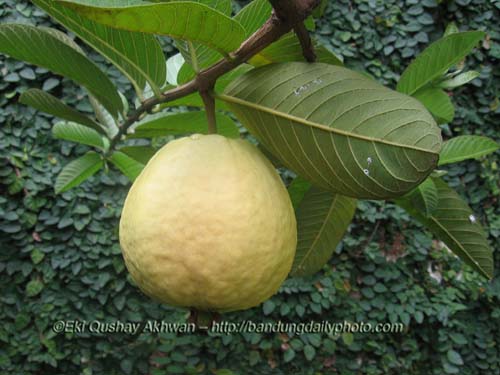
I have quite a number of plants in my small front and back yard gardens. The pink-flowered adenium at the top photo is one of my favorite flowering plants. Then there are also a couple of fruit trees which I grow in large pots. The "jambu batu" (psidium guajava) or guava is fruiting and I think will be ready for picking in a couple of weeks' time. This season's yield looks better than last year's when some sort of leave flea attacked it and almost killed it.

Jambu Batu Copyrights Eki Akhwan
"Jambu Batu" (guava)

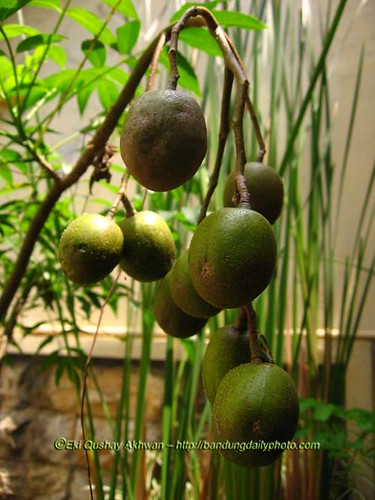
The "kedongdong" (spundias dulcis) - a fruit tree that can only be found in Southeast Asia - is also fruiting generously this season, and I think the fruits will also be ready for picking in a couple of weeks' time. So, I can expect to have an abundance of tropical fruit supply from my own garden this coming weeks. :)

Kedongdong Copyrights Eki Akhwan
"Kedongdong"

Now that we are talking about fruits, Bandung's (and in general the western parts of Indonesia's) fruit season usually takes place between September and January. During this period, different kinds of tropical fruits are in season one after another. If you are a tropical fruit lover, it's the best time to go and hunt for them; that is, if you don't mind the rainy season, which normally takes place at the same time as the fruit season.

Have a good weekend, everybody.

Saturday, August 23, 2008

Colors of The Rain - A Global Warming Symptom?

3 Agustus 2008 CANON A 510 011


Text and picture by Eki Qushay Akhwan

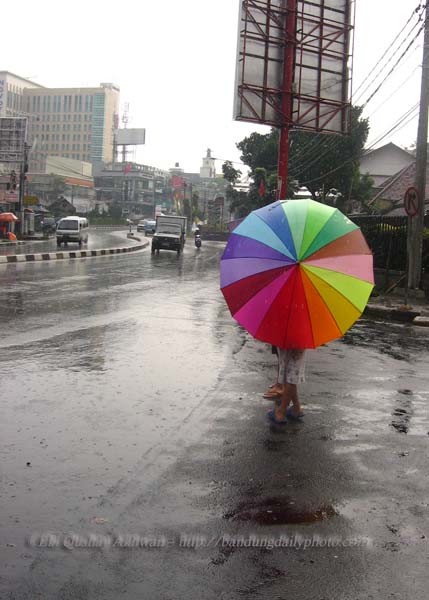
There have been quite a number of weather surprises here lately. August is supposed to be the height of the dry season in Bandung, but there have been a few days where rains fall unexpectedly. While they are a welcome respite from the dry spell, they are a bit surprising nonetheless.

I took this photo earlier in the month on Jalan Wastukancana, Bandung. It was sunny when I left home for the downtown. Some 30 minutes later, the rain began to fall. As I was on my motorcycle, I had to stop. And while I was waiting for the rain to stop, a couple of kids came into sight with their colorful umbrellas. They were playing in the rain. So I took out my camera and began shooting. This was one of the snapped photos.

Weather irregularity is probably a symptom of global warming. Here is what wikipedia says about it.

Wednesday, August 20, 2008

Bandung Countryside #2 and The Strawberry Story

morning in bandung 1

Text and pictures by Eki Qushay Akhwan

This is another photo I took at my morning countryside walk with some colleagues recently.

As I said before, Bandung may be a bustling metropolis, but the countrysides surrounding it are still very rural and scenic; better still, they are never far away. This scenic panorama of a village in Cikole area, for example, is located only 17 kilometers (about 10 miles) north of Bandung.

Being located on a highland and surrounded by mountains and volcanoes, Bandung's soil is very fertile. Combine that with the mild and cool climate, what you get is abundance of agriculture produce (I said here, Bandung and West Java in general have the largest and most productive tea plantations in the country). Bandung is a major producer and one of the largest suppliers of vegetables on the island of Java.

Bandung Strawberry


Strawberry, or more precisely garden strawberry (Fragaria X Ananassa), the most common variety of strawberry cultivated worldwide, is the offspring of the accidental cross between North American strawberry (Fragaria Virginiana) whose nice flavor is very well known, and bigger-sized Chilean stawberry (Fragaria Chiloensis). This plant was first cultivated in Europe in the 18th century. There is a large varieties of stawberry cultivated worldwide, but this garden stawberry is supposed to be their Adam and Eve ^_^, including those cultivated in Bandung.

"Strawberry Tourism" (my term) is now very popular in Bandung. A lot of stawberry gardens are now open for the sole purpose of entertaining visitors's curiosity about this non-native plant. In these places you can pick this savory fruit yourselves, then weigh your picks and pay them at the cashier. Prices range from about 20,000 rupiahs (about US$2.2) to 30,000 (about US$ 3.3) per kilogram, depending on size and ripeness.

Saturday, August 16, 2008

Bandung Countryside

Bandung Morning View


Text and picture by Eki Qushay Akhwan

While Bandung is a busy and bustling metropolis (it is the fourth largest city in Indonesia), the countryiside surrounding it is still basically very rural and surprisingly very close.

I took this photo at a village near Cikole, Lembang, some 17 kilometers north of Bandung sometime ago on my morning walk with some colleagues from the office. The best time to have a countryside walk in Bandung is early in the morning like this (about 5:30 a.m.) when the sun barely rises. The beauty of the scenenery covered in thin fog and the cool and fresh morning air, to me, are so inviting.

Saturday, August 9, 2008

Walini Tea Plantation

Ciwalini Tea Plantation

Text and picture by Eki Qushay Akhwan

Located on a high land and surrounded by mountains, Bandung and its surrounding areas have long been known for their ideal climate and fertility for agroindustry. This potential was well exploited by the Dutch to plant commodity crops such as tea, coffee, and quinine.

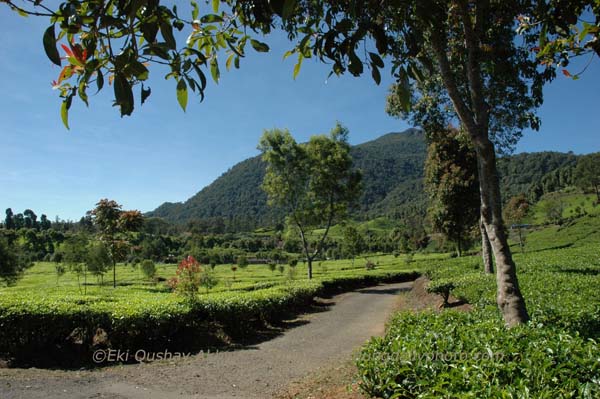
Huge tea, coffee, and quinine plantations can be found in the north and south of Bandung. Pictured above is Walini tea plantation located near Kawah Putih (White Crater). This plantation is now owned and managed by a state-owned company PT Perkebunan VIII (Persero). In addition to being a productive plantation producing high quality high land tea, this plantation is now also being offered as an agrotourism destination where visitors can have tea walk, horse ride, and other activities. Right in the middle of this plantation, there is also a natural hot water pool where visitors can swim or have a relaxing hot bath in private bathrooms.

Photography tip of the day: Landscape photography #2
Another thing that we can do to improve the impact of our landscape photographs is to place an object of interest in the foreground to create a sense of depth. In the picture above, the tree I placed in the foreground and the path helped create a sense of depth in the landscape.

Friday, August 8, 2008

Negeri di Atas Awan - A Land over the Clouds

080808A

080808B

Text and pictures by Eki Qushay Akhwan

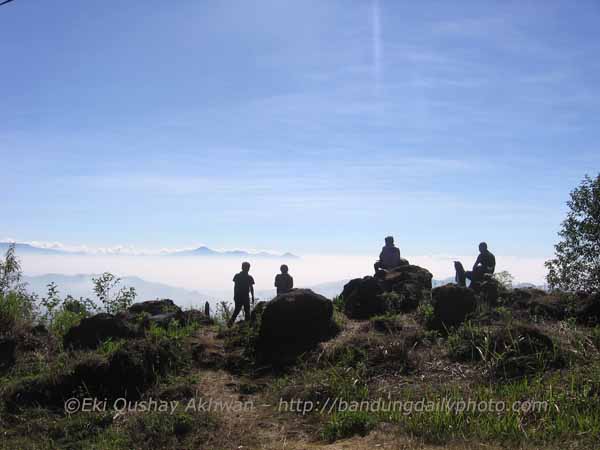
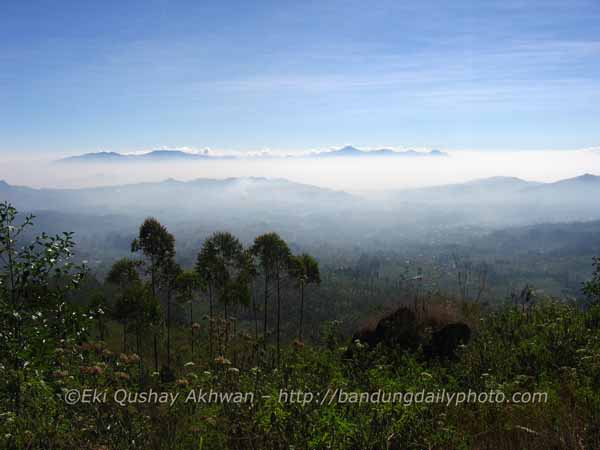
On the way up to Kawah Putih (White Crater), there is a forest clearing right on the side of road where we can see the whole mountain range in the South of Bandung. The view from this high vantage point is so breathtaking, that it's worth stopping by just to sit and enjoy the view. To me, it's also a great place to reflect upon the greatness of nature and of our place in it.

Photography tip of the day: Landscape Photography
I took these pictures with a small point and shoot camera, my faithful Canon Powershot A510. I didn't have much control over the exposure. But even with a point and shoot pocket camera, great landscape photographs can still be made. With landscape photography, one of the things we can do to improve the impact of our photographs is to find a high vantage point which could give you a commanding point of the scene. If you have an SLR camera, which gives you control over the exposure, set the aperture to the smallest (larger f number, e.g. f/11, f/16, f/22) to give a wider/deeper Depth of Field, so that every detail will be sharp and in focus.

Thursday, August 7, 2008

KAWAH PUTIH (The White Crater): The Legend

KAWAH PUTIH 2


Text and picture by Eki Qushay Akhwan

Before being discovered in 1837, the people who lived around Mt. Patuha believed that the mountain top was a sacred place, haunted by the holy spirits of their the their ancestors. They would never venture anywhere near the mountain top's forests. A trespass like that would mean bad luck or even death. They also believed that on certain nights these spirits would have a meeting discussing the security and welfare of their people and the conservation of the forests and the natural recources that supported their livelihood.

The legend had had the beauty of Kawah Putih hidden and the pristine forests surrounding it preseved for centuries until its discovery in 1837.

A note about the color of the water:
Kawah Putih is a crater lake that covers an active (fumarolic) volcano which has been dormant since 1600. As such they water is typically acidic, saturated with volcanic gases, and cloudy with a strong greenish color. (Wikipedia: Crater Lake).

kawah putih 3


Wednesday, August 6, 2008

KAWAH PUTIH - The White Crater

3 Agustus 2008 CANON A 510 101B


Text and picture by Eki Qushay Akhwan

A Singaporean photographer friend, his wife, and their Malaysian friends came to visit this weekend. I took them to Kawah Putih (which literally means White Crater) in the south of Bandung on Sunday.

Kawah Putih is arguably one of the most beautiful crater lakes on the island of Java, and quite probably in the Indonesian archipelago. It is located about 46 kilometers south of Bandung on Patuha mountain (2,434 meters above sea level). The crater was discovered by a Dutch-German botanist and platation estate owner Franz Wilhelm Junghuhn in 1837. According to geologists, this crater lake was created as a result of Mt. Patuha volcanic erruption in the year 1000 - 1200.

More photos and stories about it on tomorrow's post.

Saturday, August 2, 2008

HELAR Fest 2008: The Sudden Rain

Text and pictures by Eki Qushay Akhwan

There are a number of festivals going on in Bandung in July and August. One of them is the HELAR Fest 2008. This festival is an annual creative art fest held to promote Bandung as an emerging center for the creative art industry in the country and regionally (I'll tell you more about it in tomorrow's post).

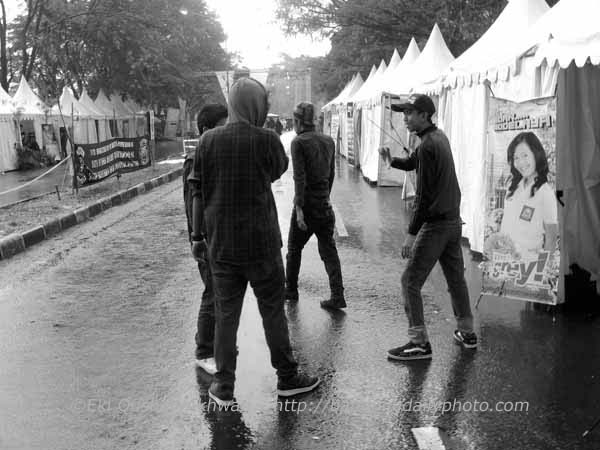
Anyway, as I did not have to go to work today, I decided to go to there this afternoon. The event was very impressive and visually entertaining. Then the rain started to fall. (August is the peak of the dry season in Bandung and we don't usually expect rain to fall this time of the year. So, the rain was actually a nice cooling break from the heat of dry season.)

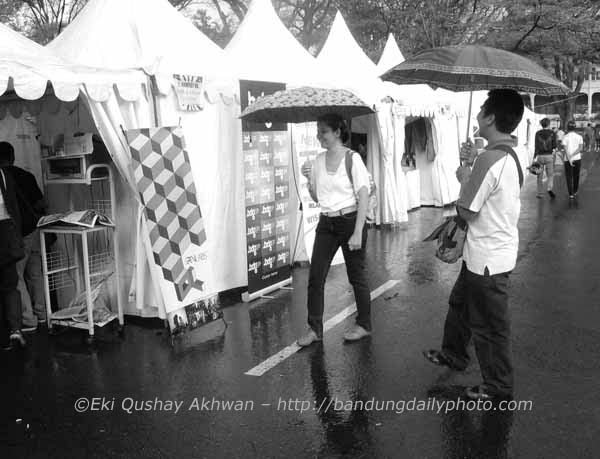
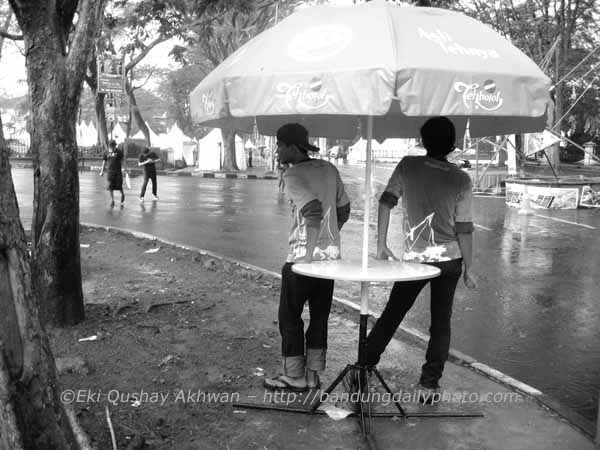
I was a bit discouraged at first, but, observing how people reacted to the sudden rain through my camera's view finder, I began to realize that it was actually very interesting photographically. So I began to take pictures again, and here are some of them:

IMG_6586BB

Some of them didn't seem to care about getting wet like these teenagers. It was not a heavy rain after all.

IMG_6611C

Some seemed to have been prepared with umbrellas (I don't know how they knew it was going to rain).

IMG_6576BA

Still, some prefered to find a shelter and waited till the rain stopped, like these two stand attendants who had just had their lunch at a tent cafe when the rain began to fall.

Thursday, July 3, 2008

Ciwalini Hot Water Spring Pool


Text and pictures by Eki Qushay Akhwan

Ciwalini is the name a place in the south of Bandung and a large tea plantation where this hot water spring and open air pool is located. Being surrounded by mountains and active volcanoes, Bandung naturally has a number of hot water springs. Unlike some other hot water springs which have become commercialized resorts, however, Ciwalini remains a popular destination.


Wednesday, July 2, 2008

"Summer" Rain


Text and picture by Eki Qushay Akhwan

There is of course no summer in a tropical city like Bandung. We have only two seasons: Musim kemarau (dry season), which normally lasts between April and October, and musim penghujan (wet or rainy season) between November and March. So I did not expect that it would be raining when I set out on my motorbike to Bandung Culinary Festival last Saturday. But it did. And it was quite heavy. The sudden downpour had forced many motorbikers like myself to find a shelter from the rain. This place - a small patch of park under the Pasupati Bridge/flyover - was the choice for many who happened to be around or passing the area. While waiting for the rain to stop, I took out my camera and had a look around to see if there was anything I could photograph and share with you. Here is one of them.

Tuesday, June 24, 2008

Bandung Sunset


Text and picture ©Eki Qushay Akhwan

This sunset could be anywhere. We share the same earth, the same sun. But this is what I saw, here where I live.

UNDER THE SAME ROOF

The sun is what unites us:
It’s the sun that shines upon us

Blesses us with lives.

When it sets in my hemisphere
It raises in yours

Night is only a flip, of morning
Time of sleep, time of raising

When it raises in your hemisphere
It raises in ours

Distance may there be between us
But you and I are us

May peace be upon you